Indian Art & Culture: 50 Most Important Topics for UPSC
Indian art and culture is one of the most scoring areas of the UPSC syllabus — and one of the most beloved by paper-setters. GS Paper I devotes an entire section to it, and Prelims typically draws 8–12 questions from architecture, dance, music, religion, philosophy, festivals and heritage institutions. Unlike polity or economy, art and culture cannot be cracked by logic alone: it rewards familiarity with names, places, styles and timelines. The good news is that the question bank is finite — the same temples, caves, dances and councils return year after year in slightly new clothing.
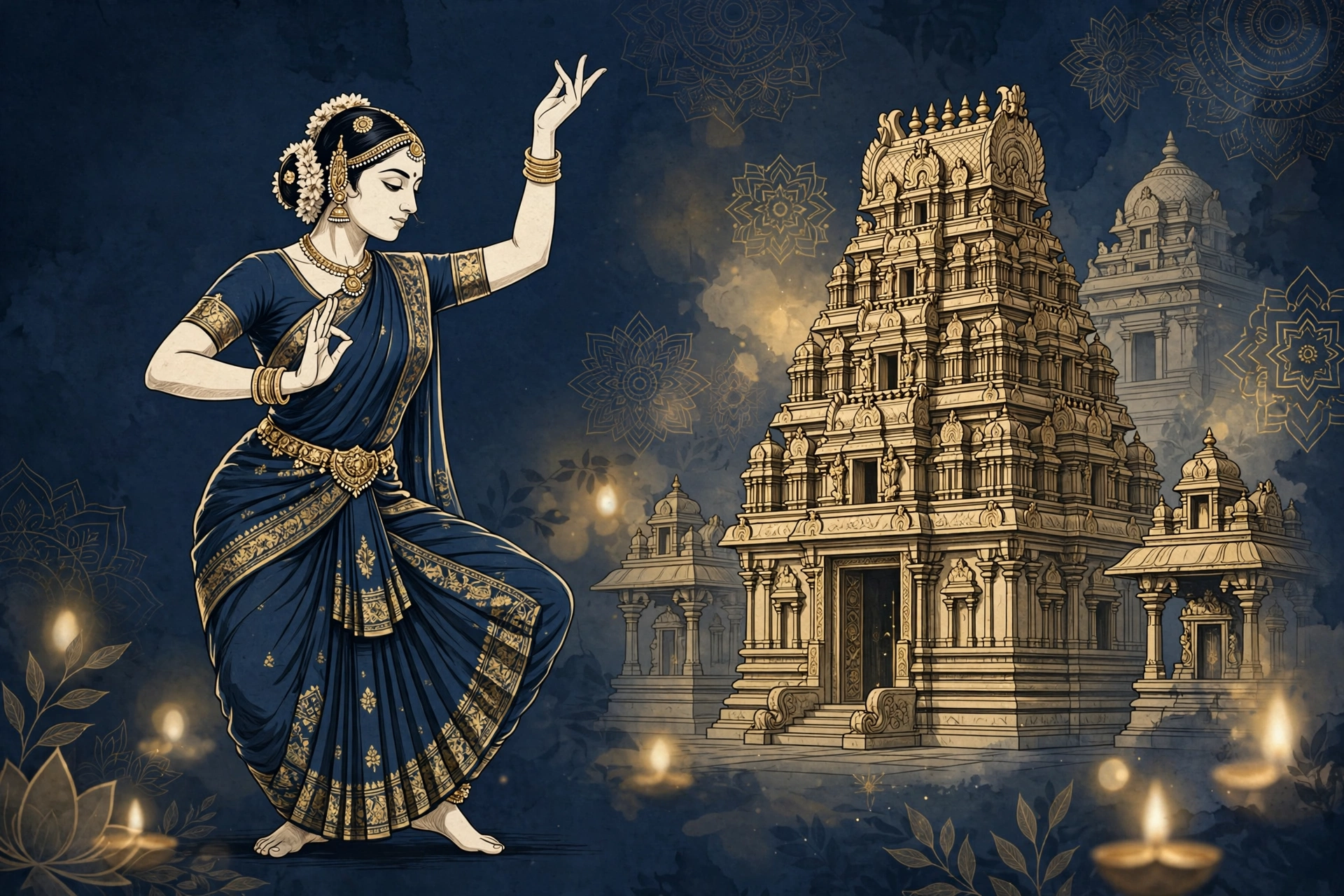
These 50 topics cover the complete art and culture syllabus: architecture, sculpture and painting from the Harappans to Lutyens’ Delhi; the eight classical dances, both music systems, theatre and literature; the great religions and philosophies born in India; festivals, UNESCO sites, languages, crafts and the institutions that protect them all. Every topic has a quick-revision table plus exam-oriented notes — what it is, why it matters, the key facts, and exactly how UPSC tests it. Use the table of contents below to jump straight to any topic.
📥 Download the Complete PDF Notes — Free!
📑 Table of Contents
Part I: Architecture, Sculpture & Painting
- 1. Harappan Architecture & Town Planning
- 2. Mauryan Art: Pillars, Stupas & Edicts
- 3. Buddhist Architecture: Stupas, Chaityas & Viharas
- 4. Rock-Cut Architecture: Ajanta, Ellora & Elephanta
- 5. Gupta Temple Architecture
- 6. Nagara, Dravida & Vesara Temple Styles
- 7. Pallava & Chola Architecture
- 8. Vijayanagara Architecture: Hampi
- 9. Sultanate Architecture: Qutub Minar to Lodis
- 10. Mughal Architecture: Fatehpur Sikri to Taj Mahal
- 11. Colonial & Modern Architecture: Lutyens’ Delhi
- 12. Sculpture Schools: Gandhara, Mathura & Amaravati
- 13. Chola Bronze Sculpture: The Nataraja
- 14. Prehistoric & Mural Paintings: Bhimbetka to Ajanta
- 15. Miniature Paintings: Mughal, Rajput & Pahari
- 16. Bengal School & Modern Indian Art
- 17. Folk Paintings: Madhubani, Warli, Gond & More
Part II: Dance, Music, Theatre & Literature
- 18. Bharatanatyam
- 19. Kathak
- 20. Kathakali & Mohiniyattam
- 21. Odissi, Kuchipudi, Manipuri & Sattriya
- 22. Folk Dances of India
- 23. Hindustani Classical Music
- 24. Carnatic Classical Music
- 25. Musical Instruments & Maestros
- 26. Sanskrit Drama & Folk Theatre
- 27. Puppetry Traditions of India
- 28. Sangam Literature
- 29. Sanskrit Literature: Kalidasa & Others
- 30. Bhakti & Sufi Literature
- 31. Medieval to Modern Indian Literature
- 32. Urdu & Persian Contributions
- 33. Indian Cinema & Culture
Part III: Religion, Philosophy, Festivals & Heritage Institutions
- 34. Hinduism: Beliefs, Sects & Pilgrimage
- 35. Buddhism: Teachings, Councils & Schools
- 36. Jainism: Teachings, Tirthankaras & Sects
- 37. Sikhism, Zoroastrianism & Other Faiths
- 38. Six Schools of Indian Philosophy
- 39. Bhakti & Sufi Movements
- 40. Major Festivals of India
- 41. Kumbh Mela, Fairs & Pilgrimage Circuits
- 42. UNESCO World Heritage Sites in India
- 43. ASI, Museums & Cultural Institutions
- 44. GI Tags & Cultural Heritage
- 45. Languages of India & the Eighth Schedule
- 46. Classical Languages of India
- 47. Martial Arts: Kalaripayattu & Others
- 48. Textiles & Handicrafts of India
- 49. Science & Mathematics in Ancient India
- 50. How to Prepare Art & Culture for UPSC
Part I: Architecture, Sculpture & Painting
1. Harappan Architecture & Town Planning
| Key fact | Detail |
|---|---|
| Period | Mature Harappan phase, roughly 2600–1900 BCE |
| Town plan | Raised citadel plus lower town; grid-pattern streets; covered drainage |
| Great Bath | Mohenjo-daro — watertight ritual bathing tank |
| Dockyard | Lothal (Gujarat) — tidal dock for sea trade |
| Dholavira | Gujarat — series of water reservoirs and an inscribed signboard |
What it is: The Harappan (Indus Valley) civilisation, flourishing roughly between 2600 and 1900 BCE, was the first urban civilisation of the Indian subcontinent — among the ancient world’s most carefully planned cities. Settlements from Mohenjo-daro in Sindh to Dholavira in Gujarat were divided into a raised citadel for the elite and public buildings, and a lower town for common residents. Streets ran in a neat grid pattern, houses opened onto lanes rather than main roads, and nearly every house had a private well and a covered drain connected to larger sewers.
Why it matters: Harappan planning is the benchmark against which UPSC compares every later Indian city — and a rare case where Indian urbanism leads world history rather than following it. The covered drainage system, standardised fired bricks in a fixed 1:2:4 ratio, the Great Bath’s watertight construction and Lothal’s dockyard all point to a society that could mobilise labour, enforce standards and manage water at scale. That is evidence of organised administration long before written law, and it makes the Harappans the default example for any question on early urbanisation.
Key facts: Major sites: Mohenjo-daro (Great Bath, granary, assembly hall), Harappa (granaries), Lothal (dockyard and bead factory), Dholavira (reservoirs and a famous inscribed signboard) and Kalibangan (a ploughed field and fire altars). Drains had inspection holes for cleaning, and bricks were baked to uniform size. No temples or palaces of the Egyptian or Mesopotamian type have been found — the Great Bath’s ritual function is inferred, not proven. The Harappan script remains undeciphered, so all interpretation rests on archaeology alone.
How UPSC tests it: Prelims loves matching questions — Great Bath to Mohenjo-daro, dockyard to Lothal, reservoirs to Dholavira, ploughed field to Kalibangan. Statement questions test the citadel-and-lower-town division, the grid pattern and the 1:2:4 brick ratio. Map-based questions ask the state or modern country of major sites. In Mains, Harappan planning is the standard opening example for answers on water management and urbanisation — and it links naturally to our Indian history notes for the wider ancient-India picture.
2. Mauryan Art: Pillars, Stupas & Edicts
| Key fact | Detail |
|---|---|
| Period | 4th–2nd century BCE; Ashoka reigned c. 268–232 BCE |
| Lion Capital | Sarnath — four lions on an abacus; India’s national emblem |
| Edicts | 14 major rock edicts and 7 pillar edicts; Prakrit in Brahmi script |
| Stupas | Sanchi stupa begun under Ashoka; Bharhut railing and gateways |
| Polish | Mirror-like “Mauryan polish” on Chunar sandstone pillars |
What it is: Mauryan art is India’s first great imperial art, created when the Mauryan empire gave the subcontinent its first large-scale stone architecture. Its icons are the Ashokan pillars — tall, monolithic sandstone columns crowned with animal capitals, the most famous being the four-lion capital at Sarnath, which independent India adopted as its national emblem. Ashoka also had his moral instructions, the dhamma edicts, carved on rocks and pillars across the empire in Prakrit written in Brahmi script. He and his successors raised stupas, beginning the great stupa at Sanchi, and decorated them with carved railings and gateways.
Why it matters: The Mauryans mark the moment Indian art becomes public, political and permanent. Before them, most building was in perishable wood and brick; after them, stone carried the state’s message across the subcontinent. The edicts are simultaneously art, administration and history — they tell us what Ashoka believed, how far his writ ran, and how he tried to rule by moral persuasion rather than force. For the exam, this is the root of two giant topics: Buddhist architecture and the Indian emblem itself.
Key facts: The Sarnath capital shows four lions back to back on an abacus carved with a dharma chakra, a bull, a horse and an elephant; the motto “Satyameva Jayate” below it comes from the Mundaka Upanishad. The pillars were quarried at Chunar near Varanasi and transported hundreds of kilometres — itself a statement of imperial organisation. The most famous edict sites include Girnar, Dhauli, Jaugada and Kalsi. Stupa building continued at Bharhut, where the railing medallions narrate Jataka stories in early Indian sculpture.
How UPSC tests it: Prelims asks what the Sarnath capital depicts, where “Satyameva Jayate” comes from, the language and script of the edicts, and which ruler is associated with the Sanchi stupa’s beginnings. A classic statement question claims the edicts were in Sanskrit — they were in Prakrit. In Mains, Ashokan art illustrates answers on statecraft, the spread of Buddhism and the idea of moral kingship; it also pairs with questions on India’s national symbols.
3. Buddhist Architecture: Stupas, Chaityas & Viharas
| Key fact | Detail |
|---|---|
| Stupa | Hemispherical mound over relics; circumambulation path (pradakshina patha) |
| Parts | Anda (dome), harmika, chhatra (umbrella), torana (gateway), vedika (railing) |
| Chaitya | Prayer hall with apsidal end housing a stupa |
| Vihara | Monastery residence for monks; cells around a courtyard |
| Finest example | Sanchi — toranas carved with Jataka tales; a UNESCO World Heritage Site |
What it is: Buddhist architecture gave India three building types that shaped two thousand years of sacred building. The stupa is a hemispherical mound raised over the Buddha’s relics (or those of great monks), designed for circumambulation — devotees walk clockwise around it on the pradakshina patha. Its elements form a vocabulary: the anda (dome), the harmika (square railing on top), the chhatra (umbrella spire) and the torana (ornamental gateway). The chaitya is a prayer hall with an apsidal, horseshoe-shaped end where a small stupa stands for worship. The vihara is the monastery itself — monks’ cells arranged around a courtyard or hall.
Why it matters: These three forms are the ancestors of much of Indian architecture. The stupa’s dome evolved into the temple shikhara’s logic of a sacred mountain; the chaitya hall’s apsidal plan became the model for rock-cut prayer halls at Karle and Bhaja; the vihara’s courtyard plan survives in monasteries and even college quadrangles. Buddhism’s missionary energy carried the stupa across Asia — from Sanchi to Sarnath to Borobudur — making it India’s most exported architectural idea.
Key facts: Sanchi’s four toranas, added under the Shungas and Satavahanas, are carved with scenes from the Buddha’s life and the Jatakas, and are among the finest narrative sculpture in India. The great chaitya at Karle (1st century CE) has a soaring vaulted interior with a colonnade, often called the finest of its kind. Viharas at Nalanda and Taxila show the monastery evolving into a university. Later stupas, like those at Amaravati, grew elaborate sculpted railings telling the Buddha’s story in marble-like limestone.
How UPSC tests it: Prelims tests the vocabulary relentlessly — match anda, harmika, torana and pradakshina patha to their meanings; distinguish chaitya (prayer hall) from vihara (residence). Sanchi’s toranas and the Karle chaitya are favourite specific questions. In Mains, Buddhist architecture supports answers on the spread of Buddhism, art as religious propaganda and the transition from rock-cut to structural building.
4. Rock-Cut Architecture: Ajanta, Ellora & Elephanta
| Key fact | Detail |
|---|---|
| Ajanta | 29 caves, Maharashtra; Buddhist murals and sculpture; 2nd century BCE–5th century CE |
| Ellora | 34 caves — Buddhist, Hindu and Jain; Kailasa temple carved top-down from one rock |
| Elephanta | Island near Mumbai; colossal Trimurti (three-faced Shiva) |
| Patronage | Satavahanas and Vakatakas at Ajanta; Rashtrakutas at Ellora (Kailasa) |
| UNESCO | Ajanta, Ellora and Elephanta are all World Heritage Sites |
What it is: Rock-cut architecture is exactly what it sounds like: temples and monasteries excavated directly out of living rock, carved from the top down so the building emerges from the cliff face. Ajanta’s 29 caves in Maharashtra, hollowed out in two phases between the 2nd century BCE and the 5th century CE, are Buddhist chaityas and viharas whose walls carry India’s greatest surviving ancient paintings. Ellora’s 34 caves run the full religious spectrum — 12 Buddhist, 17 Hindu and 5 Jain — crowned by the Kailasa temple, a complete Shiva temple carved downward out of a single basalt cliff under the Rashtrakutas. Elephanta, on an island near Mumbai, holds the colossal Trimurti: Shiva as creator, preserver and destroyer in one three-faced bust.
Why it matters: These caves compress a thousand years of Indian religious art into three cliff faces. Ajanta’s murals show us how ancient Indians dressed, danced and worshipped — a visual encyclopedia no text can match. Ellora proves that Buddhism, Hinduism and Jainism could flourish side by side, literally in adjacent caves. The Kailasa temple remains an engineering marvel: removing some 200,000 tonnes of rock with hammers and chisels, working from the roof downward, with no room for error.
Key facts: Ajanta’s paintings were done in tempera on a mud-plaster surface — scenes from the Jatakas, courtly life and the Buddha’s life, with the famous Padmapani Bodhisattva in Cave 1. The Kailasa temple (Cave 16, Ellora) was commissioned by the Rashtrakuta king Krishna I in the 8th century CE. Elephanta’s Trimurti stands about six metres tall and is dated to the 5th–6th century CE, probably under the Kalachuris. All three sites sit in Maharashtra, a favourite Prelims trap for their states.
How UPSC tests it: Prelims asks which religion dominates Ajanta (Buddhist), the patron of the Kailasa temple (Rashtrakutas), what the Trimurti depicts, and the states of all three sites. Statement questions test the top-down carving technique and the date range of Ajanta. In Mains, the caves illustrate religious tolerance, the rock-cut to structural transition and art as historical evidence for social life.
5. Gupta Temple Architecture
| Key fact | Detail |
|---|---|
| Period | 4th–6th century CE — the formative age of the Hindu temple |
| Dashavatara Temple | Deogarh (UP) — early shikhara over the sanctum; Vishnu temple |
| Key features | Garbhagriha (sanctum), shikhara (tower), mandapa (hall); stone construction |
| Brick example | Bhitargaon temple (UP) — among the oldest surviving brick temples |
| Sculpture | Sarnath Buddha images; Ganga and Yamuna as door guardians |
What it is: The Gupta age (4th–6th century CE) is when the Hindu temple as we know it takes form — the moment worship moves from open-air shrines and rock caves into a purpose-built stone house for the deity. The formula crystallises: a garbhagriha (the dark inner sanctum holding the image), a shikhara (the curving tower rising above it, symbolising the cosmic mountain), and a mandapa (the pillared hall where devotees gather). The Dashavatara Temple at Deogarh in Uttar Pradesh, dedicated to Vishnu, shows this grammar nearly complete, with sculpted panels of Vishnu’s legends on its walls. At Bhitargaon, the same ideas were executed in brick rather than stone.
Why it matters: Every later temple in India — from Khajuraho to Thanjavur — is a variation on the Gupta template. The Guptas standardised the parts and their meanings: the sanctum as the womb-chamber of the deity, the tower as Mount Meru, the doorway flanked by the river goddesses Ganga and Yamuna as purifiers. Sculpture reached a classical peak too — the serene Sarnath Buddha, with its transparent drapery and inward gaze, became the ideal Buddhist image across Asia. This is why the Gupta period is called the classical age of Indian art.
Key facts: Other Gupta temples include Tigova and Nachna-Kuthara in Madhya Pradesh and the Eran temples. The Deogarh Dashavatara temple is dated to the early 6th century CE and carries the famous panel of Vishnu reclining on the serpent Shesha. Gupta sculpture is marked by restraint — smooth modelling, spiritual calm and minimal ornament — in contrast to both earlier heaviness and later exuberance. The Allahabad pillar inscription of Samudragupta, though a political record, sits at the heart of this artistic flowering.
How UPSC tests it: Prelims asks for the location of the Dashavatara Temple (Deogarh), the components of a Gupta temple (garbhagriha, shikhara, mandapa) and the brick temple at Bhitargaon. A repeated question: which period saw the beginning of structural temple architecture — the Guptas. In Mains, Gupta temples anchor answers on the “classical age” thesis and the evolution of temple forms.
6. Nagara, Dravida & Vesara Temple Styles
| Key fact | Detail |
|---|---|
| Nagara | North India — tall curvilinear shikhara; e.g. Khajuraho, Konark Sun Temple |
| Dravida | South India — pyramidal vimana, massive gopuram gateways, pillared halls |
| Vesara | Deccan hybrid of Nagara and Dravida; e.g. Hoysala temples at Belur and Halebidu |
| Shared parts | Garbhagriha (sanctum), mandapa (hall); shikhara (Nagara) vs vimana (Dravida) |
| Khajuraho | Chandela dynasty, Nagara style; UNESCO World Heritage Site |
What it is: Indian temple architecture divides into three great regional styles. The Nagara style of the north raises a tall, curving shikhara over the sanctum — a beehive-like tower built of diminishing tiers that seems to press upward, seen at Khajuraho and the Sun Temple at Konark. The Dravida style of the south builds a stepped, pyramidal vimana over the sanctum and surrounds the complex with towering gopuram gateways, vast pillared halls and water tanks — the Brihadeeswara Temple at Thanjavur is its monument. The Vesara style of the Deccan blends the two: the Hoysala temples at Belur and Halebidu combine a star-shaped plan and Dravida-derived towers with Nagara-like detailing.
Why it matters: This threefold classification is the single most-tested framework in temple architecture. It explains why a temple in Odisha looks nothing like one in Tamil Nadu despite serving the same gods — regional materials, dynasties and rituals produced distinct sacred geometries. The gopuram-versus-shikhara distinction is the fastest visual key: the tallest element in a Dravida temple is the entrance gateway, while in a Nagara temple it is the tower directly over the sanctum.
Key facts: Nagara temples often add an amalaka (ribbed disc) and kalasha (finial) atop the shikhara. Dravida complexes grew over centuries, with later dynasties adding ever-taller gopurams — at Srirangam the outer gopuram dwarfs the original shrine. The Vesara label is most associated with the later Chalukyas and Hoysalas of Karnataka. The Sun Temple at Konark (13th century, Eastern Ganga dynasty) takes the Nagara form of a colossal chariot with twelve pairs of wheels.
How UPSC tests it: Prelims constantly asks to match temples to styles — Khajuraho (Nagara), Brihadeeswara (Dravida), Hoysala temples (Vesara) — and to identify the distinguishing feature of each. Statement questions test whether the shikhara belongs to Nagara or Dravida. In Mains, the three styles illustrate regional diversity within a shared Hindu tradition, a favourite “unity in diversity” argument.
7. Pallava & Chola Architecture
| Key fact | Detail |
|---|---|
| Pallava | 7th–9th century; rock-cut rathas to structural Shore Temple at Mamallapuram |
| Shore Temple | Mamallapuram (Tamil Nadu) — granite, seashore; UNESCO site |
| Chola | 9th–13th century; Brihadeeswara Temple, Thanjavur — built by Rajaraja I, c. 1010 CE |
| Brihadeeswara | 66-metre vimana; part of the “Great Living Chola Temples” UNESCO listing |
| Gangaikonda Cholapuram | Rajendra I’s temple-city celebrating his northern expedition |
What it is: The Pallavas and Cholas built the Dravida tradition in two acts. The Pallavas (7th–9th century) began by carving entire temples out of rock at Mamallapuram — the five monolithic rathas, each a different shrine form, and the giant open-air relief popularly called Arjuna’s Penance — then graduated to structural stone with the Shore Temple, standing in granite against the Bay of Bengal. The Cholas (9th–13th century) scaled this language up to imperial size: Rajaraja I’s Brihadeeswara Temple at Thanjavur, completed around 1010 CE, raises a 66-metre vimana over the sanctum, while his son Rajendra I built Gangaikonda Cholapuram to commemorate his expedition to the Ganges.
Why it matters: Pallava Mamallapuram is the laboratory where Dravida architecture was invented — every later southern temple descends from its experiments. Chola Thanjavur is the style’s mature masterpiece and a statement of imperial power: its inscriptions record land grants, dance troupes and bronze donations, making the temple a readable archive of Chola administration. Together they show architecture evolving from royal experiment to state institution within four centuries.
Key facts: The Shore Temple complex includes shrines to Shiva and Vishnu and is part of the Mamallapuram UNESCO World Heritage Site. The Brihadeeswara vimana is capped by a single massive stone, traditionally said to weigh about 80 tonnes, raised by an earthen ramp. The “Great Living Chola Temples” UNESCO listing covers Thanjavur, Gangaikonda Cholapuram and Darasuram. Chola temples also functioned as banks, employers and landholders — economic hubs, not just shrines.
How UPSC tests it: Prelims asks who built the Brihadeeswara Temple (Rajaraja I), the date (c. 1010 CE), the Shore Temple’s location and dynasty, and what Gangaikonda Cholapuram commemorates. Matching Pallava/Chola monuments to dynasties is a staple. In Mains, these temples support answers on temple-as-institution, Chola statecraft and the Dravida style’s evolution.
8. Vijayanagara Architecture: Hampi
| Key fact | Detail |
|---|---|
| Capital | Hampi (Karnataka), on the Tungabhadra river; UNESCO World Heritage Site |
| Virupaksha Temple | Still-active Shiva temple; towering gopuram |
| Vittala Temple | Stone chariot shrine and musical pillars that ring when tapped |
| Golden age | Krishnadevaraya (reigned 1509–1529) |
| Style | Dravida idiom — lofty gopurams, kalyana mandapas, ornate pillared halls |
What it is: Hampi, the ruined capital of the Vijayanagara empire on the boulder-strewn banks of the Tungabhadra in Karnataka, is the grandest open-air museum of late-medieval Indian architecture. Its temples speak the Dravida language with a Vijayanagara accent: soaring gopurams, vast pillared halls, and kalyana mandapas (marriage halls) carved with teeming mythology. The Virupaksha Temple, dedicated to Shiva, has been in continuous worship for centuries and still dominates the skyline. The Vittala Temple complex holds the empire’s icon — a stone chariot with wheels that look ready to turn — and pillars that produce musical notes when tapped.
Why it matters: Vijayanagara was the last great Hindu imperial power of the south, and Hampi is its autobiography in stone. Under Krishnadevaraya (1509–1529), the empire’s wealth poured into temples, irrigation works and a cosmopolitan capital that foreign travellers described with awe. Hampi’s ruins let historians reconstruct not just religion but markets, water systems and courtly life — it is a whole city, not a single monument, which is why UNESCO listed the entire landscape.
Key facts: The empire fell after the Battle of Talikota in 1565, when a Deccan sultanate alliance sacked the capital — the ruins are partly the record of that destruction. The Hazara Rama Temple carries Ramayana panels believed to have served the royal household. Hampi’s water infrastructure — aqueducts, stepped tanks like the Pushkarini, and channels — shows Vijayanagara’s mastery of hydraulic engineering. The site was brought to scholarly attention in the 19th century through the work of Colin Mackenzie and later Alexander Greenlaw’s photographs.
How UPSC tests it: Prelims asks for Hampi’s river (Tungabhadra), its most famous ruler (Krishnadevaraya), the stone chariot’s temple (Vittala) and the battle that ended the empire (Talikota, 1565). Statement questions test whether Virupaksha is still active. In Mains, Hampi illustrates answers on medieval urbanism, temple patronage as statecraft and the Deccan’s historical role — cross-linking to our history notes on Vijayanagara.
9. Sultanate Architecture: Qutub Minar to Lodis
| Key fact | Detail |
|---|---|
| Qutub Minar | Begun by Qutb-ud-din Aibak; completed under Iltutmish; 73 metres tall |
| Quwwat-ul-Islam | Delhi’s first mosque; built with carved pillars from demolished temples |
| True arch & dome | Arrive with Alai Darwaza (Alauddin Khalji); perfected later |
| Tughlaq style | Massive sloping walls (“batter”), grey stone; Tughlaqabad fortress |
| Lodi tombs | Garden tombs; the double dome appears under the Lodis |
What it is: Sultanate architecture is the story of Islamic building traditions meeting Indian craftsmanship in Delhi between the 12th and 16th centuries. It begins with the Qutb complex: the Quwwat-ul-Islam mosque, raised by Qutb-ud-din Aibak using carved pillars taken from demolished temples, and the Qutub Minar — a 73-metre victory tower begun by Aibak and completed under Iltutmish, its five storeys banded with inscriptions. Under Alauddin Khalji came the Alai Darwaza, the first Indian building to use the true arch and true dome scientifically. The Tughlaqs built in massive grey stone with sloping walls, and the Lodis refined the garden tomb and the double dome.
Why it matters: This is where the arch, the dome and the minaret enter the Indian architectural vocabulary — elements the Mughals would later perfect. The early phase also records a cultural negotiation in stone: Hindu motifs and temple pillars reused inside mosques, Islamic calligraphy and geometry gradually Indianised. For the exam, the Sultanate is the bridge between ancient temple architecture and Mughal splendour, and its monuments are among Delhi’s most-asked landmarks.
Key facts: The Qutub Minar’s top storeys were rebuilt by Firoz Shah Tughlaq after lightning damage, which is why its profile changes partway up. The Alai Darwaza (1311) introduced the horseshoe arch and precise dome construction to India. Tughlaqabad, Ghiyas-ud-din Tughlaq’s fortress-city, shows the Tughlaq love of battered (inward-sloping) walls. Lodi garden tombs like Sikandar Lodi’s introduced the double dome — an outer shell for grandeur and an inner ceiling at human scale — a device the Mughals inherited.
How UPSC tests it: Prelims asks who began the Qutub Minar (Aibak) and who completed it (Iltutmish), which building first used the true dome (Alai Darwaza), and the distinctive Tughlaq wall feature (batter/slope). Matching rulers to monuments is standard. In Mains, Sultanate architecture illustrates Indo-Islamic synthesis and the evolution of the dome-and-arch tradition that culminates in the Taj.
10. Mughal Architecture: Fatehpur Sikri to Taj Mahal
| Key fact | Detail |
|---|---|
| Humayun’s Tomb | Delhi; garden tomb that became the prototype for the Taj |
| Fatehpur Sikri | Akbar’s red-sandstone capital; Buland Darwaza, Panch Mahal, Salim Chishti’s tomb |
| Taj Mahal | Agra; built 1632–1653 by Shah Jahan; white marble, pietra dura inlay |
| Red Fort | Delhi (Shahjahanabad); Diwan-i-Am, Diwan-i-Khas, Moti Masjid |
| Signature craft | Pietra dura (stone inlay), charbagh gardens, bulbous double domes |
What it is: Mughal architecture is the summit of Indo-Islamic building — Persian geometry, Timurid domes and Indian craftsmanship fused into monuments of unmatched refinement. The arc runs from Humayun’s Tomb in Delhi, the first great garden tomb, through Akbar’s red-sandstone capital at Fatehpur Sikri — with the soaring Buland Darwaza, the airy Panch Mahal and the white-marble tomb of Salim Chishti — to Shah Jahan’s white-marble phase: the Taj Mahal at Agra (1632–1653) and the Red Fort of Shahjahanabad in Delhi. Red sandstone gives way to marble; mass gives way to jewel-like surface decoration.
Why it matters: The Mughals turned architecture into imperial autobiography. Fatehpur Sikri records Akbar’s religious eclecticism — a mosque, a tomb of a Sufi saint, and the Diwan-i-Khas where he debated faiths all stand within one complex. The Taj is the world’s most famous expression of love rendered in stone, but it is also a theological statement: a charbagh (four-part paradise garden) with the mausoleum as the throne of God. No other Indian dynasty built so consistently at such scale, which is why Mughal monuments dominate every “match the monument” question.
Key facts: The Taj’s decoration uses pietra dura — hard stones (jasper, jade, carnelian) inlaid into white marble to form floral arabesques — and its calligraphy grows larger higher up so it reads uniformly from the ground. Humayun’s Tomb, built by his widow Haji Begum, introduced the charbagh and the high double dome to India. Fatehpur Sikri was abandoned, probably for water scarcity, within a generation of its founding. The Red Fort’s Diwan-i-Khas once held the Peacock Throne and bears the famous inscription: “If there is paradise on earth, it is here.”
How UPSC tests it: Prelims asks the Taj’s construction dates (1632–1653) and patron (Shah Jahan), what Fatehpur Sikri’s Buland Darwaza commemorates (Akbar’s Gujarat victory), and which tomb pioneered the charbagh (Humayun’s). Pietra dura and the double dome are repeated terms. In Mains, Mughal architecture illustrates cultural synthesis, imperial ideology and the economics of patronage.
11. Colonial & Modern Architecture: Lutyens’ Delhi
| Key fact | Detail |
|---|---|
| New Delhi | Designed 1912–1931 by Edwin Lutyens and Herbert Baker; inaugurated 1931 |
| Rashtrapati Bhavan | Former Viceroy’s House; Lutyens’ masterpiece blending classical and Indian motifs |
| India Gate | War memorial arch (1921–1931); Amar Jawan Jyoti added 1972 |
| Earlier colonial | Fort St. George (Chennai), Victoria Memorial (Kolkata) — Indo-Saracenic experiments |
| Modernist | Chandigarh — Le Corbusier’s planned city; Capitol Complex UNESCO-listed |
What it is: Colonial architecture is the built record of British rule, and its climax is Lutyens’ Delhi. When the capital moved from Calcutta to Delhi in 1911, Edwin Lutyens and Herbert Baker laid out an imperial city of sweeping axes — Rajpath and Janpath — anchored by the Viceroy’s House (now Rashtrapati Bhavan) on Raisina Hill, the twin Secretariat blocks, and the circular Parliament House. Lutyens fused European classicism with Indian elements: Mughal-style domes, chhatris, jaali screens and elephants carved into the stone. The earlier colonial centuries had experimented too — Fort St. George in Chennai, the Victoria Memorial in Kolkata, and the Indo-Saracenic hybrids of Mumbai’s CST station.
Why it matters: New Delhi was designed to project imperial permanence — and ironically became the stage of independent India’s democracy within sixteen years of its inauguration. Its architecture embodies a political argument: the British as legitimate successors to the Mughals, ruling from the same historic capital. Post-independence, Le Corbusier’s Chandigarh offered the counter-statement — a modernist planned city declaring a break with the colonial past. Together they frame every debate on what “Indian” architecture means today.
Key facts: Construction of New Delhi ran roughly from 1921 to 1931, with the city inaugurated in 1931. The India Gate, designed by Lutyens, honours soldiers of the First World War; the Amar Jawan Jyoti memorial to the 1971 war was added beneath it in 1972. Lutyens and Baker famously quarrelled over the gradient of Rajpath, which partially obscures the Viceroy’s House from view. Chandigarh’s Capitol Complex — the Assembly, Secretariat and High Court — joined the UNESCO World Heritage List as part of Le Corbusier’s transnational serial nomination.
How UPSC tests it: Prelims asks who designed New Delhi (Lutyens and Baker), the inauguration year (1931), what India Gate commemorates, and Le Corbusier’s Indian city (Chandigarh). The Victoria Memorial’s city (Kolkata) is a common option. In Mains, Lutyens’ Delhi illustrates colonial urbanism and the politics of capitals; Chandigarh supports answers on modernism and post-colonial nation-building.
12. Sculpture Schools: Gandhara, Mathura & Amaravati
| Key fact | Detail |
|---|---|
| Gandhara | Northwest (Taxila–Peshawar); Greco-Roman influence; Buddha in Apollo-like drapery |
| Mathura | Indigenous style; red-spotted sandstone; yakshas to Buddhas |
| Amaravati | Andhra; white limestone; narrative panels of Jataka tales |
| Period | Flourished c. 1st–3rd century CE, especially under the Kushans |
| Material key | Grey schist (Gandhara), red sandstone (Mathura), limestone (Amaravati) |
What it is: Around the 1st century CE, the Buddha — previously shown only through symbols like the wheel, the tree and footprints — began to appear in human form, and three regional schools defined how. Gandhara, in the northwest around Taxila and Peshawar, carved the Buddha with wavy hair, a moustache-less Greco-Roman face and heavy Apollo-like drapery, a legacy of Indo-Greek contact. Mathura, the indigenous heartland school, worked in red-spotted sandstone and gave the Buddha a powerful, broad-shouldered Indian body rooted in the older yaksha tradition. Amaravati in Andhra carved Jataka narratives in luminous white limestone, filling every surface with elegant, slender figures.
Why it matters: This is the birth of the Buddha image — one of the most consequential moments in world art. The debate over which school invented it first (Gandhara or Mathura) is a classic art-history controversy that UPSC loves to probe. More broadly, the three schools show how Indian art absorbed foreign influence without losing its identity: Gandhara’s drapery is Greek, but the serenity of the face is entirely Indian. Their images travelled the Silk Road and became the template for Buddhist art from Central Asia to Japan.
Key facts: Gandhara sculpture typically uses grey-blue schist and stucco; many pieces were found at Taxila and Hadda. Mathura’s workshop also produced the famous standing Buddhas and later the refined Sarnath images of the Gupta age. Amaravati’s great stupa railing, now partly in the British Museum and Chennai Museum, narrates the Buddha’s life in continuous friezes. The Kushan emperor Kanishka’s patronage (c. 78 CE onward) provided the political umbrella for all three schools’ flowering.
How UPSC tests it: Prelims asks which school shows Greco-Roman influence (Gandhara), which stone Mathura used (red-spotted sandstone), and where Amaravati is (Andhra Pradesh). Matching schools to materials or regions is a favourite. In Mains, the schools illustrate Indo-Greek cultural contact, the aniconic-to-iconic shift in Buddhism and regional diversity in classical art.
13. Chola Bronze Sculpture: The Nataraja
| Key fact | Detail |
|---|---|
| Technique | Lost-wax (cire perdue) casting — a clay core, wax model, then molten bronze |
| Nataraja | Shiva as Lord of Dance; cosmic cycle of creation and destruction |
| Symbolism | Drum (creation), fire (destruction), dwarf of ignorance underfoot, ring of flames |
| Period | Peak under the Cholas, 9th–13th century; finest examples c. 10th–11th century |
| Use | Processional images (utsava murtis) carried in temple festivals |
What it is: The Chola bronze is India’s most celebrated metal art: hollow-cast images of gods made by the lost-wax technique, in which a wax model is encased in clay, melted out, and replaced with molten bronze. Its supreme achievement is the Nataraja — Shiva as Lord of Dance, dancing within a ring of flames, one foot crushing the dwarf of ignorance, one hand holding the drum of creation and another the fire of destruction, the fourth hand raised in reassurance. Cast mainly between the 10th and 11th centuries, these were not museum pieces but living gods — utsava murtis carried in procession during temple festivals.
Why it matters: The Nataraja compresses an entire philosophy into a single image: the cosmos as rhythmic energy, creation and destruction as one dance. Art historians rank it among the world’s great sculptures, and it has become India’s global cultural signature — a Nataraja stands at CERN in Geneva as a symbol of cosmic dance. For the exam, it is the perfect case study of how technique (lost-wax), religion (Shaivism) and state patronage (Chola temples) fuse in one object.
Key facts: Lost-wax casting allowed exquisite detail — jewellery, flowing garments, expressive hands — impossible in stone at that scale. Chola queens and officials donated bronzes as recorded in temple inscriptions at Thanjavur. The iconography is precisely codified: the damru (hourglass drum) for sound-creation, agni (fire) for dissolution, the gajahasta (elephant-trunk arm) pointing to the raised foot of liberation. Major collections survive at the Thanjavur museum, Chennai’s Government Museum and temples still in worship.
How UPSC tests it: Prelims asks the casting technique (lost-wax/cire perdue), what the Nataraja symbolises, and the dynasty (Chola). A common statement question lists the objects in Shiva’s hands. In Mains, the Nataraja illustrates Chola temple culture, the philosophy encoded in Indian iconography and metal technology in ancient India.
14. Prehistoric & Mural Paintings: Bhimbetka to Ajanta
| Key fact | Detail |
|---|---|
| Bhimbetka | Rock shelters, Madhya Pradesh; prehistoric paintings; UNESCO World Heritage Site |
| Subjects | Hunting scenes, dancing figures, animals — in red and white mineral pigments |
| Ajanta murals | Tempera on mud plaster; Jataka tales, courtly life; Cave 1 Padmapani |
| Other murals | Bagh caves (MP), Sittanavasal (Tamil Nadu), Lepakshi (Andhra) |
| Time span | From the Stone Age (Bhimbetka) to the 5th century CE (Ajanta’s later caves) |
What it is: Indian painting begins tens of thousands of years before any canvas, on the rock walls of shelters like Bhimbetka in Madhya Pradesh. There, prehistoric artists painted hunting parties, dancing human figures and animals — bison, tigers, elephants — in red and white pigments made from minerals and earth, layered over millennia from the Stone Age onward. Two thousand years later, the same impulse reached its classical peak in the murals of Ajanta: Buddhist caves whose walls and ceilings carry tempera paintings of Jataka stories, royal processions and celestial beings, including the serene Padmapani Bodhisattva of Cave 1. Between them lie the Bagh caves, Sittanavasal and Lepakshi.
Why it matters: Bhimbetka is India’s oldest art gallery and proof that aesthetic expression predates civilisation itself — the paintings are also rare evidence of prehistoric social life, showing communal hunts and dances. Ajanta’s murals are the visual counterpart to Sanskrit literature: they show how people dressed, what instruments they played and how courts looked. Together they give UPSC a continuous 10,000-year arc of Indian painting in just two sites.
Key facts: Bhimbetka was discovered in 1957 by V.S. Wakankar and inscribed by UNESCO for its prehistoric rock art. Ajanta’s technique was tempera — pigments mixed with a binding medium applied to dry mud plaster, not true fresco. The paintings were executed under Vakataka patronage in the 5th century CE (the later caves). Sittanavasal’s Jain murals in Tamil Nadu and Lepakshi’s Vijayanagara-era ceiling paintings extend the mural tradition into the medieval south.
How UPSC tests it: Prelims asks Bhimbetka’s state (Madhya Pradesh), its discoverer (Wakankar), Ajanta’s painting technique (tempera/mural, not fresco), and the famous Padmapani’s cave (Cave 1). Matching mural sites to states is common. In Mains, these paintings serve as historical sources for ancient social life and as the starting point of any answer on Indian painting traditions.
15. Miniature Paintings: Mughal, Rajput & Pahari
| Key fact | Detail |
|---|---|
| Mughal | Akbar’s imperial atelier; Persian-influenced; court scenes, portraits, manuscripts |
| Rajput | Mewar, Kishangarh, Bundi; Hindu epics, Radha-Krishna; bold colours |
| Pahari | Hill courts; Basohli (bold, intense) and Kangra (delicate, lyrical) styles |
| Technique | Opaque watercolour and gold on paper (wasli); fine squirrel-hair brushes |
| Themes | Ragamala (musical modes), Bhagavata Purana, court chronicles, hunting scenes |
What it is: Miniature painting is India’s great courtly art of the 16th–19th centuries: jewel-like scenes painted in opaque watercolour and gold on paper, small enough to hold in the hand. The Mughal school, founded in Akbar’s imperial atelier by Persian masters and Indian artists working together, produced naturalistic court scenes, portraits, hunting expeditions and illustrated manuscripts like the Hamzanama. The Rajput schools — Mewar, Kishangarh, Bundi, Marwar — answered with Hindu themes: the Ramayana, the Bhagavata Purana and the love of Radha and Krishna, in flat, bold colours charged with emotion. In the Himalayan foothills, the Pahari schools split into the intense, fiery Basohli style and the delicate, lyrical Kangra style.
Why it matters: Miniatures are where India’s regional identities painted themselves. Mughal naturalism records court life with documentary precision; Rajput paintings pour bhakti emotion into colour; Kangra’s misty landscapes visualise Sanskrit poetry. The Ragamala series — paintings that give visual form to musical modes — uniquely unites painting and music. For the exam, the three schools are the standard classification question, and their themes link painting to literature, music and court culture.
Key facts: Akbar’s atelier employed over a hundred artists and illustrated Persian classics and histories; Jahangir’s reign refined portraiture and natural-history studies (Mansur’s birds and animals). Kishangarh’s Bani Thani — the elongated-eyed heroine painted under Raja Savant Singh — is Rajput art’s most famous face. Basohli’s earliest dated series illustrates the Rasamanjari (1690s). The paintings were made on wasli (layered paper) with brushes of squirrel hair, and gold and lapis lazuli for luxury manuscripts.
How UPSC tests it: Prelims asks which ruler founded the Mughal atelier (Akbar), the Bani Thani’s school (Kishangarh), Basohli vs Kangra characteristics, and what Ragamala depicts (musical modes). Matching schools to regions is a staple. In Mains, miniatures illustrate Mughal-Rajput cultural exchange, bhakti’s visual expression and the court as a site of art patronage.
16. Bengal School & Modern Indian Art
| Key fact | Detail |
|---|---|
| Bengal School | Founded by Abanindranath Tagore; revivalist; “Bharat Mata” (1905) |
| Context | Swadeshi-era nationalism; rejection of Western academic realism |
| Progressive Artists | 1947, Bombay — M.F. Husain, S.H. Raza, F.N. Souza; modernist break |
| Key figures | Nandalal Bose, Jamini Roy, Amrita Sher-Gil, Tyeb Mehta |
| Legacy | From nationalist revival to global contemporary Indian art market |
What it is: The Bengal School, founded by Abanindranath Tagore in the early 1900s, was Indian painting’s declaration of independence. Rejecting the Western academic realism taught in colonial art schools, Abanindranath and his students — Nandalal Bose, Surendranath Ganguly — revived Mughal miniatures, Ajanta murals and Japanese wash techniques to paint Indian myths and history. His “Bharat Mata” (1905), a saffron-clad goddess holding symbols of nationhood, became a Swadeshi-era icon. After independence, the Progressive Artists’ Group (1947, Bombay) — M.F. Husain, S.H. Raza, F.N. Souza — smashed the revivalist mould with bold modernism, while Jamini Roy distilled Bengali folk art and Amrita Sher-Gil fused European technique with Indian subjects.
Why it matters: The Bengal School shows art serving nationalism — painting as a Swadeshi act, parallel to the boycott of British goods. Nandalal Bose later designed the original illuminated borders of the Indian Constitution, literally framing the republic in Bengal School aesthetics. The Progressives then asked the opposite question: what does it mean to be modern and Indian at once? Their answer — Husain’s horses, Raza’s bindu — carried Indian art onto the global stage and into record auction prices.
Key facts: Abanindranath was the nephew of Rabindranath Tagore and vice-principal of the Calcutta School of Art. E.B. Havell, the school’s British principal, supported the revival against the colonial curriculum. The Progressive Artists’ Group was founded in the year of independence, 1947, in Bombay. Amrita Sher-Gil’s “Three Girls” (1933) is a landmark of Indian modernism. Nandalal Bose’s Constitution illustrations include scenes from the Ramayana, Mahabharata and India’s freedom movement.
How UPSC tests it: Prelims asks the Bengal School’s founder (Abanindranath Tagore), the painter of “Bharat Mata,” the Progressives’ founding year (1947) and its members (Husain, Raza, Souza). Jamini Roy’s folk inspiration is a common option. In Mains, the Bengal School illustrates art and nationalism; the Progressives support answers on post-independence cultural identity.
17. Folk Paintings: Madhubani, Warli, Gond & More
| Key fact | Detail |
|---|---|
| Madhubani | Bihar (Mithila); women artists; gods, nature; GI-tagged |
| Warli | Maharashtra-Gujarat tribals; white stick figures on mud walls; daily life |
| Gond | Madhya Pradesh; dots and dashes; nature spirits; Jangarh Singh Shyam |
| Pattachitra | Odisha (and Bengal); cloth scrolls; Jagannath themes |
| Kalamkari | Andhra Pradesh; hand-drawn/printed textile art; natural dyes |
What it is: India’s folk and tribal paintings are art made by communities rather than courts — painted on mud walls, cloth, paper and floors, carrying myths, harvests and daily life. Madhubani (Mithila painting) of Bihar, traditionally done by women, fills every inch with gods, peacocks and trees of life in geometric precision. The Warli tribals of Maharashtra paint white stick-figure humans dancing and farming on brown mud walls. Gond artists of Madhya Pradesh build shimmering images of nature spirits from dots and dashes. Pattachitra scrolls of Odisha narrate Jagannath legends on cloth, while Kalamkari of Andhra Pradesh draws temple stories on fabric with a bamboo pen and natural dyes.
Why it matters: These traditions keep alive visual languages far older than any academy — Warli’s stick figures echo Bhimbetka’s prehistoric hunters across ten thousand years. They are also living economies: GI tags for Madhubani and Kalamkari, and artists like Gond master Jangarh Singh Shyam, turned village walls into national galleries and global markets. For UPSC, folk paintings are the “tribal culture” answer bank — each one is a state, a community and a technique in a single frame.
Key facts: Madhubani received a GI tag and was popularised nationally when artists began painting on paper in the 1970s after a drought relief initiative. Warli painting uses only white pigment (rice paste) on a cow-dung-and-mud base, with the circle-triangle-square human form. Jangarh Singh Shyam pioneered taking Gond art from walls to canvas in the 1980s. Pattachitra’s name comes from “patta” (cloth) and “chitra” (picture); the Bengal variant is called Patua scroll painting. Kalamkari’s Srikalahasti style is entirely hand-drawn.
How UPSC tests it: Prelims is relentless here: Madhubani–Bihar, Warli–Maharashtra, Gond–Madhya Pradesh, Pattachitra–Odisha, Kalamkari–Andhra Pradesh. Statement questions test the materials (rice paste, natural dyes) and GI-tag status. In Mains, folk paintings illustrate tribal art, women’s artistic labour, GI tags as cultural protection and the commercialisation of tradition.
Part II: Dance, Music, Theatre & Literature
18. Bharatanatyam
| Key fact | Detail |
|---|---|
| Origin | Tamil Nadu; temple dance of the devadasis, revived in the 20th century |
| Text | Based on the Natya Shastra; codified in the Tanjore Quartet’s repertoire |
| Features | Aramandi (half-sitting posture), precise footwork, expressive abhinaya, Carnatic music |
| Revivalists | Rukmini Devi Arundale, E. Krishna Iyer — rescued it from social stigma |
| Repertoire | Alarippu, Jatiswaram, Shabdam, Varnam, Padam, Tillana |
What it is: Bharatanatyam is the classical dance of Tamil Nadu — and India’s most internationally recognised dance form. Performed solo, usually by a woman, it combines nritta (pure rhythmic dance), nritya (expressive storytelling) and natya (drama) to Carnatic music. The dancer’s body is a temple in motion: the aramandi half-sitting stance, geometric arm lines, thunderous footwork striking the floor, and eyes and hands (mudras) narrating stories of gods and lovers. Its traditional repertoire runs from the invocatory Alarippu through the central Varnam to the closing Tillana.
Why it matters: Bharatanatyam’s history is a parable of Indian culture’s modern rescue. As the devadasi system was abolished, the dance faced extinction under social stigma — until Rukmini Devi Arundale and E. Krishna Iyer revived it as a respectable concert art in the 1930s, founding institutions like Kalakshetra in Chennai. That revival made it the template for how all eight classical dances would later be “classicalised.” It is also the dance most directly tied to the Natya Shastra’s theory.
Key facts: The Tanjore Quartet — four brothers in the Thanjavur court of the early 19th century — composed the core repertoire still performed today. The dance is performed to Carnatic music with the nattuvanar (dance master) conducting with cymbals. Rukmini Devi removed erotic elements and added spiritual dignity during the revival, a sanitisation scholars still debate. The costume is a pleated silk sari with temple jewellery; the hair is braided with flowers.
How UPSC tests it: Prelims asks Bharatanatyam’s state (Tamil Nadu), its reviver (Rukmini Devi Arundale), the foundational text (Natya Shastra) and the accompanying music system (Carnatic). The devadasi connection is a favourite statement. In Mains, it illustrates the colonial-era reform of performing arts and the invention of “classical” tradition in modern India.
19. Kathak
| Key fact | Detail |
|---|---|
| Origin | Uttar Pradesh; storytelling tradition of the Kathakars (katha = story) |
| Evolution | Temple storytelling → Mughal court refinement → modern stage |
| Features | Rapid pirouettes (chakkars), intricate footwork with ghungroos, Hindustani music |
| Gharanas | Lucknow (grace, abhinaya), Jaipur (vigorous footwork), Banaras |
| Maestro | Birju Maharaj — the legendary Lucknow gharana exponent |
What it is: Kathak is the classical dance of North India, born with the Kathakars — hereditary storytellers who narrated the Ramayana, Mahabharata and Krishna legends in temples through dance and mime. Under the Mughal courts it absorbed Persian aesthetics: the straight-legged temple stance gave way to graceful bends, rapid chakkars (pirouettes) and dazzling tatkar footwork, with the dancer’s hundred-plus ghungroo bells becoming a percussion instrument. Performed to Hindustani music, Kathak alternates between pure rhythmic virtuosity and abhinaya that can make a single verse of poetry last twenty minutes.
Why it matters: Kathak is the living proof of Hindu-Muslim cultural synthesis — a temple storytelling art that flowered in Mughal durbars without losing its devotional soul. Its three gharanas map North India’s cultural geography: Lucknow’s nazakat (delicate grace and expression), Jaipur’s powerful footwork and Banaras’s blend of both. Birju Maharaj, who carried the Lucknow tradition into the modern era, made Kathak a global art while keeping its storytelling heart intact.
Key facts: The word Kathak comes from “katha” (story) plus “kar” (doer). Dancers wear ankle bells numbering a hundred or more; the footwork’s rhythmic syllables (bols) are recited by the tabla player and dancer together. The Lucknow gharana was nurtured in the court of Wajid Ali Shah. Kathak’s signature pieces include the tukra, toda and paran — rhythmic compositions of increasing complexity — alongside thumri-based abhinaya.
How UPSC tests it: Prelims asks Kathak’s state of origin (Uttar Pradesh), its gharanas (Lucknow, Jaipur, Banaras), the legendary maestro (Birju Maharaj) and the meaning of “katha.” The Mughal-court evolution is a common statement. In Mains, Kathak illustrates Indo-Islamic synthesis and the gharana system as a vehicle of artistic transmission.
20. Kathakali & Mohiniyattam
| Key fact | Detail |
|---|---|
| Kathakali | Kerala; dance-drama; elaborate makeup, huge skirts, all-night Ramayana/Mahabharata plays |
| Mohiniyattam | Kerala; solo female dance of the “enchantress”; gentle swaying, white-gold kasavu sari |
| Kathakali features | Chenda and maddalam drums; stylised mudras; green (pacha) = noble heroes |
| Tradition | Kathakali is all-male traditionally; Mohiniyattam is lasya (graceful) to Kathakali’s tandava energy |
| Revival | Vallathol Narayana Menon founded Kerala Kalamandalam (1930) for both arts |
What it is: Kerala gave India two contrasting classical dances. Kathakali is dance-drama on an epic scale: all-night performances of the Ramayana and Mahabharata by actors in towering headgear, painted faces and billowing skirts, communicating entirely through codified mudras and facial expression while singers narrate and chenda drums thunder. The green-faced pacha characters are noble heroes; the bearded kathi are arrogant villains. Mohiniyattam is its mirror image — a solo female dance of swaying, wave-like grace in a white sari with a gold border (kasavu), embodying the enchantress Mohini, performed to Carnatic music with restrained, lyrical abhinaya.
Why it matters: Kathakali is India’s most theatrical classical form — closer to opera than to solo dance — and its makeup code is a complete semiotic system examiners love: face colour instantly tells you a character’s moral nature. Mohiniyattam, nearly extinct by the early 20th century, was revived alongside Kathakali through Vallathol’s Kerala Kalamandalam (1930), making Kerala the model for institutional rescue of classical arts. Together they show how one region can produce both the most masculine and the most feminine of Indian dances.
Key facts: Kathakali’s makeup takes hours; the chundipoo (red flower) on the forehead and the white rice-paste borders (chutti) framing the face are its signatures. Performances traditionally run dusk to dawn in temple courtyards. Mohiniyattam’s repertoire includes cholkettu, varnam and padam, with the dancer’s gentle side-to-side sway evoking palm fronds and ocean waves. Both forms were recognised among the eight classical dances by the Sangeet Natak Akademi.
How UPSC tests it: Prelims asks both dances’ state (Kerala), what Kathakali’s green face signifies (noble/heroic character), Mohiniyattam’s costume (white-gold kasavu sari) and the Kalamandalam’s founder (Vallathol). The all-male tradition of Kathakali is a common statement. In Mains, they illustrate Kerala’s cultural distinctiveness and the institutional revival of classical arts.
21. Odissi, Kuchipudi, Manipuri & Sattriya
| Key fact | Detail |
|---|---|
| Odissi | Odisha; tribhanga (three-bend) posture; temple dance of the maharis |
| Kuchipudi | Andhra Pradesh; dance-drama from Kuchipudi village; includes singing by dancers |
| Manipuri | Manipur; Ras Leela of Radha-Krishna; gentle, veiled, devotional |
| Sattriya | Assam; monastery (sattra) tradition of the Vaishnavite saint Srimanta Sankardev; recognised as classical in 2000 |
| Key detail | Odissi’s tribhanga and chowka stances; Kuchipudi’s tarangam (dancing on a brass plate) |
What it is: Four classical dances complete the octet, each rooted in a region’s devotional life. Odissi, from Odisha’s temples, sculpts the body into the tribhanga — the three-bend pose seen on Konark’s walls — alternating with the square, masculine chowka stance; it was the dance of the mahari temple servants, revived in the 20th century. Kuchipudi of Andhra Pradesh began as a male dance-drama tradition in one Brahmin village, with dancers who sing their own lines; its showpiece is the tarangam, danced on the rim of a brass plate. Manipuri flows like no other Indian dance — veiled, gliding, worshipful — performing the Ras Leela of Radha and Krishna. Sattriya grew in Assam’s Vaishnavite monasteries (sattras) under the saint Srimanta Sankardev, and was recognised as classical only in 2000.
Why it matters: These four show that “classical” is a living, expandable category — Sattriya’s 2000 recognition proves the canon is not frozen. Odissi links dance directly to temple sculpture: its poses are Konark come alive. Manipuri carries the gentle Vaishnavism of the northeast into the national mainstream, and Kuchipudi’s singing dancers break the usual dancer-singer division. For the exam, this group is the highest-yield matching set after the Kerala pair.
Key facts: Odissi’s revival leaders included Kelucharan Mohapatra; its music is the distinct Odissi style with the pakhawaj drum. Kuchipudi’s Bhama Kalapam (the story of Satyabhama) is its signature dance-drama. Manipuri’s Ras Leela was shaped by the 18th-century king Bhagyachandra; dancers wear the stiff, barrel-like potloi skirt. Sattriya’s monastery tradition includes male monks (bhakats) performing as Krishna and the gopis, with the khol drum and cymbals.
How UPSC tests it: Prelims matches each dance to its state — Odissi–Odisha, Kuchipudi–Andhra Pradesh, Manipuri–Manipur, Sattriya–Assam — and asks which was recognised in 2000 (Sattriya). The tribhanga pose (Odissi) and tarangam plate dance (Kuchipudi) are favourite specifics. In Mains, Sattriya’s late recognition supports answers on how “classical” status is constructed.
22. Folk Dances of India
| Key fact | Detail |
|---|---|
| Bhangra / Giddha | Punjab; harvest celebration; dhol drum |
| Garba / Dandiya | Gujarat; Navratri; circular dances around the goddess |
| Lavani | Maharashtra; powerful, quick-tempo performance with dholki |
| Chhau | Eastern India (Jharkhand/WB/Odisha); masked martial dance; UNESCO Intangible Heritage |
| More | Rouff (Kashmir), Bihu (Assam), Yakshagana-adjacent Bayalata, Ghumra (Odisha) |
What it is: Beyond the eight classical dances lies a continent of folk dances — community celebrations of harvest, worship and the seasons, performed in villages rather than concert halls. Punjab’s Bhangra (and women’s Giddha) explodes with harvest joy to the dhol; Gujarat’s Garba circles the goddess through nine nights of Navratri, sticks clacking in Dandiya Raas. Maharashtra’s Lavani is fierce and fast, performed to the dholki. The masked Chhau of Jharkhand, West Bengal and Odisha fuses martial movement with mythology and is recognised by UNESCO as Intangible Cultural Heritage. Assam’s Bihu, Kashmir’s Rouff and Odisha’s Ghumra complete a map where every state dances differently.
Why it matters: Folk dances are the cultural fingerprint of each state — UPSC uses them as the fastest state-identity questions in the paper. They also carry social history: Bhangra’s harvest rhythms, Garba’s goddess devotion, Chhau’s martial past. Unlike classical forms with written theory, folk dances are transmitted orally and communally, making them fragile — urbanisation and the decline of agrarian ritual threaten many. Their UNESCO listings (Chhau, and Garba more recently) show the state stepping in to protect them.
Key facts: Chhau exists in three styles — Purulia (masked, West Bengal), Seraikella (Jharkhand) and Mayurbhanj (Odisha, unmasked). Garba’s name comes from “garbha” (womb), honouring the goddess as the source of life. Bihu is tied to Assam’s agricultural calendar with three seasonal Bihus. Lavani’s quick tempo and powerful delivery made it the voice of Maharashtra’s common people, from tamasha stages to freedom-movement songs.
How UPSC tests it: Prelims matches dances to states relentlessly — Bhangra–Punjab, Garba–Gujarat, Lavani–Maharashtra, Bihu–Assam, Rouff–Kashmir, Chhau’s three regions. UNESCO intangible listings are asked. In Mains, folk dances illustrate regional cultural identity, the classical-folk divide and intangible heritage conservation.
23. Hindustani Classical Music
| Key fact | Detail |
|---|---|
| Region | North India; evolved with Persian influence from the Sultanate-Mughal era |
| Core forms | Dhrupad (ancient, austere), Khayal (romantic, improvisational), Thumri, Tappa |
| Gharana system | Hereditary schools — Gwalior, Kirana, Jaipur-Atrauli, Agra, Patiala |
| Structure | Raga (melodic framework) + Tala (rhythmic cycle); alap–jor–jhala development |
| Legends | Tansen (Akbar’s court), Bhimsen Joshi, Kishori Amonkar, Bade Ghulam Ali Khan |
What it is: Hindustani music is North India’s classical tradition, shaped by centuries of interaction between Vedic chant, folk melody and Persian musical ideas under the Sultanates and Mughals. Its soul is the raga — a melodic framework with ascending and descending scales, characteristic phrases and an associated mood and time of day — unfolded through improvisation over a tala (rhythmic cycle). The oldest vocal form, Dhrupad, is austere and meditative; Khayal (“imagination”), which dominates today, gives the artist vast freedom to ornament and improvise; lighter forms like Thumri and Tappa carry romantic and devotional expression. Knowledge passes through gharanas — hereditary schools like Gwalior, Kirana and Jaipur-Atrauli, each with guarded stylistic secrets.
Why it matters: Hindustani music is the audible record of Indo-Islamic synthesis — Amir Khusrau is traditionally credited with inventing the sitar and tabla and shaping early Khayal, while Tansen, Akbar’s legendary court musician, fused Hindu and Persian streams. The gharana system shows how India preserved complex knowledge orally for centuries without notation. For the exam, the Hindustani–Carnatic contrast is the fundamental music question, and the gharanas are a favourite list.
Key facts: A raga performance typically opens with the alap (slow, unmetered exploration), then jor and jhala build rhythmic intensity before the composition (bandish) begins. Tansen’s legendary ragas — Deepak (fire) and Malhar (rain) — belong to court mythology. The harmonium, though ubiquitous today, is a European import Indianised in the 19th century. Major festivals like the Sawai Gandharva (Pune) and Dover Lane (Kolkata) keep the tradition public.
How UPSC tests it: Prelims asks the Hindustani–Carnatic regional divide, the gharana names, Dhrupad vs Khayal characteristics, and Tansen’s patron (Akbar). Amir Khusrau’s musical innovations are a repeated question. In Mains, Hindustani music illustrates cultural synthesis, oral knowledge systems and the guru-shishya parampara — and pairs with previous-year questions on medieval cultural history.
24. Carnatic Classical Music
| Key fact | Detail |
|---|---|
| Region | South India — Tamil Nadu, Karnataka, Andhra Pradesh, Kerala |
| Trinity | Tyagaraja, Muthuswami Dikshitar, Syama Sastri (late 18th–early 19th century) |
| Character | Composition-centred (kriti); devotional; less improvisation than Hindustani |
| Structure | Varnam–Kriti–Ragam-Tanam-Pallavi concert format; 72-melakarta raga system |
| Legends | M.S. Subbulakshmi, Semmangudi Srinivasa Iyer, M. Balamuralikrishna |
What it is: Carnatic music is South India’s classical tradition — more composition-centred and devotional than its northern sibling. Where Hindustani music foregrounds improvisation, Carnatic concerts revolve around the kriti, a composed song with pallavi (refrain), anupallavi and charanam sections, mostly in Telugu, Sanskrit, Tamil or Kannada, addressed to the gods. The “Trinity” — Tyagaraja, Muthuswami Dikshitar and Syama Sastri, contemporaries in Thanjavur around 1800 — composed the core repertoire still sung today. The 72-melakarta system classifies ragas with mathematical precision, and concerts follow a set arc from varnam through kritis to the improvisational ragam-tanam-pallavi centrepiece.
Why it matters: Carnatic music preserved the ancient Indian musical theory of the Natya Shastra and Sangita texts more directly than the Persian-influenced north, making it the conservative pole of Indian classical music. Its devotional character — Tyagaraja’s thousands of kritis to Rama — shows bhakti flowing through sound. The December “music season” in Chennai, with hundreds of concerts, is the world’s largest classical music gathering and a living institution UPSC occasionally references.
Key facts: Tyagaraja’s Pancharatna kritis are sung in unison by thousands at his Thiruvaiyaru memorial every January. M.S. Subbulakshmi, the first musician to receive the Bharat Ratna (1998), carried Carnatic music worldwide; her recording of “Venkatesa Suprabhatam” wakes Tirupati’s deity daily. The violin — a Western import — was Indianised into Carnatic music in the 19th century and is now indispensable. Purandara Dasa (16th century) is honoured as the “father” of Carnatic music for systematising its pedagogy.
How UPSC tests it: Prelims asks the Trinity’s names, the Bharat Ratna musician (M.S. Subbulakshmi), the region (South India) and the Hindustani–Carnatic differences. Purandara Dasa’s title is a favourite. In Mains, Carnatic music illustrates bhakti’s cultural depth, the preservation of classical theory and Tamil Nadu’s cultural institutions.
25. Musical Instruments & Maestros
| Key fact | Detail |
|---|---|
| Stringed | Sitar (Ravi Shankar), Sarod (Amjad Ali Khan), Veena, Santoor (Shivkumar Sharma) |
| Percussion | Tabla (Zakir Hussain), Mridangam (Carnatic), Pakhawaj, Ghatam |
| Wind | Bansuri flute (Hariprasad Chaurasia), Shehnai (Bismillah Khan), Nadaswaram |
| Classification | Tata (stringed), Sushira (wind), Avanaddha (percussion), Ghana (solid idiophones) |
| Icons | Ravi Shankar took the sitar global; Bismillah Khan played at the Red Fort in 1947 |
What it is: Indian classical music speaks through a distinctive orchestra of instruments, classified since the Natya Shastra into four families: tata (stringed), sushira (wind), avanaddha (covered percussion) and ghana (solid instruments like cymbals). The sitar and sarod carry Hindustani melody; the veena and the violin anchor Carnatic concerts. The tabla — a pair of tuned drums — is North India’s rhythmic engine, while the mridangam drives the south. The bansuri (bamboo flute) and the shehnai (double-reed) sing with a voice-like quality, and the santoor, a hammered dulcimer from Kashmir, found classical status through Shivkumar Sharma. Behind each instrument stands a maestro who defined it for the modern age.
Why it matters: The maestros are how UPSC tests instruments — Ravi Shankar (sitar), Zakir Hussain (tabla), Bismillah Khan (shehnai), Hariprasad Chaurasia (flute) and Amjad Ali Khan (sarod) are permanent fixtures of the question bank. Their stories also carry national meaning: Bismillah Khan played the shehnai at the Red Fort on the eve of independence in 1947; Ravi Shankar carried Indian music to Woodstock and the West. The fourfold classification itself is a direct Prelims question from the Natya Shastra tradition.
Key facts: Zakir Hussain took the tabla to global fusion collaborations while rooted in the Punjab gharana. M.S. Subbulakshmi remains the only Carnatic vocalist with a Bharat Ratna. The nadaswaram, the south’s piercing temple wind instrument, is considered mangal vadya (auspicious). The ghatam (clay pot) and kanjira (frame drum) show how everyday objects became classical instruments. Instrumental jugalbandis (duets) between Hindustani and Carnatic artists symbolise musical unity.
How UPSC tests it: Prelims matches maestros to instruments — Shankar–sitar, Hussain–tabla, Bismillah Khan–shehnai, Chaurasia–flute, Amjad Ali Khan–sarod — and asks the four instrument families with examples. In Mains, the maestros illustrate India’s soft power and the guru-shishya transmission of instrumental craft.
26. Sanskrit Drama & Folk Theatre
| Key fact | Detail |
|---|---|
| Natya Shastra | Bharata’s treatise (c. 200 BCE–200 CE) — the bible of Indian dramaturgy; rasa theory |
| Kalidasa | Abhijnana Shakuntalam, Vikramorvashiyam, Malavikagnimitram |
| Other masters | Bhasa, Shudraka (Mrichchhakatika), Bhavabhuti, Harsha |
| Folk theatre | Nautanki (UP), Tamasha (Maharashtra), Bhavai (Gujarat), Jatra (Bengal), Yakshagana (Karnataka) |
| Rasa theory | Eight/nine rasas — aesthetic flavours led by shringara (love) and karuna (pathos) |
What it is: India’s theatre tradition begins with Bharata’s Natya Shastra, a treatise of staggering scope — composed around the turn of the Common Era — that theorises drama, dance and music through the rasa theory: art succeeds when it awakens one of the eight (later nine) aesthetic flavours, from love (shringara) to wonder (adbhuta), in the audience. Kalidasa, the tradition’s supreme playwright, wrote the Abhijnana Shakuntalam — the love story of Shakuntala and Dushyanta that Goethe admired — alongside Vikramorvashiyam and Malavikagnimitram. Around this classical core grew a forest of folk theatres: Nautanki in UP, Tamasha in Maharashtra, Bhavai in Gujarat, Jatra in Bengal and the spectacular all-night Yakshagana of coastal Karnataka.
Why it matters: The Natya Shastra is the foundation text of all Indian performing arts — dance, music and drama alike claim descent from it, making it the single most cited work in art-culture questions. Rasa theory gave India an aesthetic philosophy two millennia before European equivalents. Folk theatre shows the tradition democratised: Bhavai and Tamasha carried social satire and devotional stories to villages, and during the freedom movement, stages like these carried nationalist messages too.
Key facts: Shudraka’s Mrichchhakatika (The Little Clay Cart) is celebrated for making a commoner its hero — unusual in classical drama. Bhavabhuti’s Uttararama Charita explores the Ramayana’s tragic dimensions. Harsha, the 7th-century emperor, wrote Ratnavali and Nagananda. Yakshagana’s elaborate costumes and all-night episodes from the epics make it Karnataka’s signature stage art. The Sangeet Natak Akademi documents and supports these forms today.
How UPSC tests it: Prelims asks the Natya Shastra’s author (Bharata), Kalidasa’s three plays, Shudraka’s work, and matches folk theatres to states — Nautanki–UP, Tamasha–Maharashtra, Bhavai–Gujarat, Jatra–West Bengal, Yakshagana–Karnataka. Rasa theory’s essence is a repeated question. In Mains, Sanskrit drama illustrates classical aesthetics and the folk forms support answers on regional culture.
27. Puppetry Traditions of India
| Key fact | Detail |
|---|---|
| Kathputli | Rajasthan; string puppets; Bhat community performers; epics and folk heroes |
| Bommalattam | Tamil Nadu; string puppets combined with rod techniques |
| Togalu Gombeyaata | Karnataka; leather shadow puppets; Ramayana-Mahabharata all-night shows |
| Other forms | Glove puppets (Kerala’s Pavakoothu), rod puppets (West Bengal’s Putul Nach) |
| Stories | Epics, local legends, moral tales — travelling village entertainment |
What it is: Indian puppetry is among the world’s oldest, with the Natya Shastra itself referencing puppeteers. Rajasthan’s Kathputli — string puppets worked by the Bhat community — is the most famous: brightly costumed wooden dolls dancing to folk songs, narrating the epics and the ballads of local heroes like Amar Singh Rathore. Tamil Nadu’s Bommalattam blends string and rod techniques for elaborate mythological plays. Karnataka’s Togalu Gombeyaata uses translucent leather shadow puppets, their coloured silhouettes enacting all-night Ramayana and Mahabharata episodes behind a lit screen. Kerala’s Pavakoothu (glove puppets) and Bengal’s Putul Nach (rod puppets) complete the spectrum.
Why it matters: Puppetry was rural India’s travelling theatre, cinema and moral classroom in one — puppeteers carried news, myths and social messages from village to village centuries before mass media. Its decline with television makes it a textbook case of intangible heritage under threat, which is exactly why UPSC asks about it. The forms also demonstrate regional ingenuity: the same epics told through strings in Rajasthan, shadows in Karnataka and gloves in Kerala.
Key facts: Kathputli puppeteers traditionally belong to the Bhat caste of storytellers; their performances combine puppetry with folk music and acrobatics. Shadow puppetry’s leather figures are intricately perforated so coloured light glows through them. The puppets’ repertoire overlaps with folk theatre — the same Amar Singh Rathore ballads appear in both. Government cultural bodies and NGOs now run puppetry workshops to keep the crafts alive among younger performers.
How UPSC tests it: Prelims matches forms to states — Kathputli–Rajasthan, Bommalattam–Tamil Nadu, Togalu Gombeyaata–Karnataka, Pavakoothu–Kerala. Shadow vs string vs glove vs rod classification is a favourite. In Mains, puppetry illustrates intangible heritage, the economics of folk artists and pre-modern mass communication.
28. Sangam Literature
| Key fact | Detail |
|---|---|
| What | Earliest Tamil literature; anthologies of poems from the Sangam academies |
| Period | Roughly 300 BCE–300 CE (the “Sangam age”) |
| Tolkappiyam | Oldest Tamil grammar work; also covers poetics and social life |
| Tirukkural | Thiruvalluvar’s 1,330 couplets on virtue, wealth and love — Tamil moral classic |
| Epics | Silappadikaram and Manimekalai — the twin Tamil epics |
What it is: Sangam literature is the earliest body of Tamil writing — anthologies of short poems said to have been composed in the academies (sangams) of the Pandya kings at Madurai. Divided into Ettuthokai (Eight Anthologies) and Pattuppattu (Ten Idylls), the poems split into akam (inner, love) and puram (outer, war and public life) themes, painting a vivid picture of Tamilakam’s kings, merchants, ports and landscapes. Around this corpus stand the Tolkappiyam, the oldest Tamil grammar and poetics, and the Tirukkural — Thiruvalluvar’s 1,330 crisp couplets on aram (virtue), porul (wealth) and inbam (love), revered as Tamil Nadu’s moral compass.
Why it matters: Sangam literature is the foundation of Tamil cultural identity and proof of a sophisticated South Indian civilisation contemporary with the Mauryas and Satavahanas — a powerful counter to north-centric histories. The poems document Indo-Roman trade (Roman gold for pepper and pearls), the Chera-Chola-Pandya rivalries and an ethical world distinct from Sanskrit norms. The Tirukkural’s universal ethics have made it one of the most translated works in Indian literature.
Key facts: The twin epics Silappadikaram (the anklet story of Kannagi) and Manimekalai (a Buddhist epic) belong to the post-Sangam age but complete the classical Tamil canon. Sangam poems name Roman traders (yavanas) and describe the port of Puhar (Kaveripattinam). The poems were preserved on palm-leaf manuscripts and first printed in the colonial era by scholars like U.V. Swaminatha Iyer, who rescued them from obscurity. Akam poetry uses landscape (tinai) as emotional symbolism.
How UPSC tests it: Prelims asks the Tirukkural’s author (Thiruvalluvar), the Tolkappiyam’s nature (grammar), the twin epics’ names and the Sangam age’s timeframe. The akam–puram distinction appears in statement questions. In Mains, Sangam literature supports answers on Tamil history, Indo-Roman trade and the plurality of India’s literary traditions.
29. Sanskrit Literature: Kalidasa & Others
| Key fact | Detail |
|---|---|
| Kalidasa | Abhijnana Shakuntalam (play), Meghaduta (lyric), Raghuvamsha and Kumarasambhava (epics) |
| Era | Traditionally placed in the Gupta age (4th–5th century CE) |
| Other poets | Bharavi (Kiratarjuniya), Magha (Shishupalavadha), Bhavabhuti (plays) |
| Fables | Panchatantra (Vishnu Sharma), Hitopadesha — India’s global story exports |
| Legacy | Shakuntalam translated worldwide; Meghaduta pioneered the “messenger poem” |
What it is: Sanskrit literature’s classical peak is Kalidasa — poet and playwright traditionally placed in the Gupta age, whom Indian tradition honours as the greatest kavi. His Abhijnana Shakuntalam dramatises the Mahabharata’s love story of Shakuntala and Dushyanta with a psychological depth that stunned Goethe when it reached Europe. His lyric Meghaduta (Cloud Messenger) sends a love message on a monsoon cloud across a lovingly mapped India, inventing the “messenger poem” genre. His epics Raghuvamsha (the Raghu dynasty) and Kumarasambhava (the birth of Kartikeya) set the standard for mahakavya. Around him stand Bharavi, Magha and Bhavabhuti — and the story literature of the Panchatantra, which travelled to Persia, Arabia and Europe.
Why it matters: Kalidasa is India’s Shakespeare in the exam’s eyes — the single most asked literary figure. His works distil the Gupta “classical age” ideal: nature as emotion, love as spiritual discipline, kingship as dharma. The Panchatantra’s global journey (translated as Kalila wa Dimna in Arabic) makes it India’s earliest cultural export. For Mains, Sanskrit kavya is the standard example of classical aesthetics and the courtly culture that produced it.
Key facts: The Meghaduta’s cloud route from Ramagiri to Alaka doubles as a poetic map of monsoon India. Bharavi’s Kiratarjuniya and Magha’s Shishupalavadha, with Kalidasa’s works, form the traditional “great five” epics’ core. Bana’s Harshacharita is both biography and the first historical kavya. Dandin’s Dashakumaracharita pioneered prose romance. Sanskrit drama’s stage conventions — the sutradhara (stage manager), the vidushaka (jester) — come alive in these plays.
How UPSC tests it: Prelims asks Kalidasa’s works by genre (Shakuntalam–play, Meghaduta–lyric, Raghuvamsha–epic), the Panchatantra’s author (Vishnu Sharma) and the Gupta-age association. Matching poets to works is a staple. In Mains, Kalidasa illustrates the classical age, Indian aesthetics and literature as historical evidence for Gupta society.
30. Bhakti & Sufi Literature
| Key fact | Detail |
|---|---|
| Bhakti saints | Alvars and Nayanars (Tamil); Kabir, Tulsidas, Mirabai, Surdas (north) |
| Key works | Ramcharitmanas (Tulsidas), Kabir’s dohas, Mirabai’s bhajans |
| Sufi voices | Amir Khusrau (Persian/Hindavi), Baba Farid, Bulleh Shah |
| Language shift | Vernaculars replace Sanskrit — Tamil, Hindi, Bengali, Marathi, Punjabi |
| Spirit | Direct devotion; rejection of ritual hierarchy; Hindu-Muslim synthesis |
What it is: Between the 6th and 17th centuries, Indian literature underwent a devotional revolution. The Tamil Alvars (Vaishnavite) and Nayanars (Shaivite) sang passionate hymns to temple gods, gathered in the Divya Prabandham and Tevaram. In the north, Kabir’s blunt dohas mocked both pandit and mullah; Tulsidas’s Ramcharitmanas retold the Ramayana in Awadhi and became North India’s bible; Mirabai’s bhajans poured a woman’s defiant love for Krishna into song; Surdas sang the child Krishna of Braj. Alongside flowed Sufi poetry — Amir Khusrau’s Persian and Hindavi verses, Baba Farid’s Punjabi couplets (enshrined in the Sikh Adi Granth), Bulleh Shah’s ecstatic Punjabi kafis.
Why it matters: This literature democratised both religion and language — it took devotion out of Sanskrit and ritual and put it into the people’s tongues, creating modern Hindi, Bengali, Marathi and Punjabi literatures in the process. Kabir and the Sufis built bridges across the Hindu-Muslim divide that rulers could not. For the exam, bhakti-Sufi literature is the cultural wing of the medieval movements, inseparable from questions on religious reform and vernacularisation.
Key facts: Tulsidas composed the Ramcharitmanas in the late 16th century, partly in Varanasi. Kabir (c. 1440–1518), the weaver-saint of Varanasi, was claimed by both Hindus and Muslims after his death — his dohas survive in the Bijak and the Adi Granth. Amir Khusrau (1253–1325), disciple of Nizamuddin Auliya, is credited with blending Persian and Indian musical and poetic forms. Tukaram and Eknath carried bhakti into Marathi; Chaitanya electrified Bengali Vaishnavism.
How UPSC tests it: Prelims matches saints to works and languages — Tulsidas–Ramcharitmanas–Awadhi, Kabir–dohas, Mirabai–bhajans, Surdas–Brajbhasha — and asks the Alvar-Nayanar distinction (Vishnu vs Shiva devotees). Amir Khusrau’s master (Nizamuddin Auliya) recurs. In Mains, this literature illustrates the bhakti movement, vernacularisation and composite culture.
31. Medieval to Modern Indian Literature
| Key fact | Detail |
|---|---|
| Medieval | Court chronicles, bhakti vernaculars; Persian histories (Baburnama, Akbarnama) |
| Colonial turn | Novel, short story, essay arrive; print capitalism; Bankim, Premchand |
| Tagore | Rabindranath Tagore — Gitanjali; Nobel Prize 1913; national anthems of India and Bangladesh |
| Premchand | Godan, Gaban — Hindi-Urdu realism; peasants and the nationalist middle class |
| Jnanpith | India’s highest literary award (1961); Tagore, Mahadevi Varma, Amitav Ghosh among recipients |
What it is: Indian literature’s medieval centuries were dominated by court chronicles in Persian — Babur’s candid Baburnama, Abul Fazl’s Akbarnama — and the flowering bhakti vernaculars. Colonialism then rewired everything: print, English education and new prose genres (the novel, the short story, the essay) created modern Indian literature. Bankim Chandra’s Anandamath gave the freedom movement “Vande Mataram”; Premchand’s Godan and Gaban made Hindi-Urdu fiction the conscience of peasant India; Rabindranath Tagore’s Gitanjali won the Nobel Prize in 1913, and his songs became the national anthems of India and Bangladesh. Post-independence writing — from Mahadevi Varma to Amitav Ghosh — took Indian stories global.
Why it matters: Modern Indian literature is inseparable from nationalism: novels imagined the nation before politics achieved it, and “Vande Mataram” marched in fiction before it marched in streets. The Jnanpith Award (1961) institutionalised literary prestige across languages. For UPSC, this topic connects culture to the freedom movement — literature questions often hide inside modern-history answers, and vice versa.
Key facts: Tagore remains the only Indian Nobel laureate in Literature (1913, for Gitanjali’s English version). Premchand wrote first in Urdu (as Nawab Rai) then Hindi, embodying the shared Hindustani literary world. Bankim’s Anandamath (1882) is set against the Sannyasi rebellion. The Sahitya Akademi (1954) promotes literature in all recognised languages. Dalit literature — from Marathi pioneers to contemporary voices — forced open the canon from the 1970s onward.
How UPSC tests it: Prelims asks Tagore’s Nobel year (1913), Premchand’s famous novels (Godan, Gaban), Bankim’s “Vande Mataram” novel (Anandamath) and the Baburnama’s author (Babur). The Jnanpith’s status (highest literary award) is asked. In Mains, literature illustrates nationalism’s cultural roots and the making of modern Indian languages.
32. Urdu & Persian Contributions
| Key fact | Detail |
|---|---|
| Persian | Court language of the Sultanate-Mughal era; histories, poetry, administration |
| Urdu | Born in military camps and courts; Ghalib, Mir, Iqbal, Faiz |
| Ghalib | Mirza Ghalib — the supreme Urdu ghazal master; Delhi’s Mughal twilight |
| Iqbal | “Sare Jahan Se Achha”; philosophical poetry; Pakistan’s national poet |
| Forms | Ghazal, nazm, marsiya, masnavi — refined in Lucknow and Delhi mushairas |
What it is: Persian was the language of power in medieval India — the Sultanate and Mughal courts wrote histories, poetry and farmans in it, from Amir Khusrau’s verses to Abul Fazl’s Akbarnama. Out of the military camps (the word “urdu” itself relates to the army camp) and the mixed culture of Delhi and the Deccan rose Urdu, which by the 18th century had become North India’s language of refined poetry. Mir Taqi Mir gave it melancholy depth; Mirza Ghalib made the ghazal a vehicle for philosophical wit amid the Mughal empire’s twilight; Muhammad Iqbal’s “Sare Jahan Se Achha” became an Indian patriotic anthem even as his later thought inspired Pakistan; Faiz Ahmed Faiz carried the ghazal into progressive, revolutionary territory.
Why it matters: Urdu is the supreme example of India’s composite culture — a language born of Sanskrit’s Prakrits, Persian’s vocabulary and Indian soil, belonging fully to neither “Hindu” nor “Muslim” pigeonholes. Its mushaira culture made poetry a public, participatory art. For the exam, Urdu-Persian literature is the literary face of Indo-Islamic synthesis, and its poets are among the most quoted figures in Indian culture questions.
Key facts: Ghalib (1797–1869) lived through 1857 and recorded Delhi’s destruction in poignant Persian and Urdu. Iqbal wrote “Sare Jahan Se Achha” in 1904, long before his Pakistan advocacy. The marsiya (elegy) reached its peak with Mir Anis and Dabir in Lucknow’s Muharram culture. Premchand began as an Urdu writer, a reminder that the Hindi-Urdu divide is modern. Urdu is today an Eighth Schedule language with a rich press and cinema presence.
How UPSC tests it: Prelims asks Ghalib’s era and city (Delhi, late Mughal), Iqbal’s famous song, Faiz’s progressive poetry and Persian’s status as court language. The ghazal–nazm–marsiya forms are matched to descriptions. In Mains, Urdu illustrates composite culture and the politics of language in modern India.
33. Indian Cinema & Culture
| Key fact | Detail |
|---|---|
| Beginning | Raja Harishchandra (1913, Dadasaheb Phalke) — India’s first feature film |
| Talkies | Alam Ara (1931) — first Indian sound film |
| Masters | Satyajit Ray (Pather Panchali, 1955); Ritwik Ghatak, Mrinal Sen, Adoor Gopalakrishnan |
| Recognition | Dadasaheb Phalke Award — Indian cinema’s highest honour |
| Scale | India produces the most films annually of any country; pan-Indian and regional industries |
What it is: Indian cinema began in 1913 when Dadasaheb Phalke’s Raja Harishchandra — a mythological silent film — flickered onto Bombay screens; the talkies arrived with Alam Ara in 1931. What followed was the world’s most prolific film culture: Hindi cinema’s song-and-dance epics, and powerful regional industries in Tamil, Telugu, Bengali, Malayalam and Marathi. Its artistic summit is Satyajit Ray’s Pather Panchali (1955), the Apu Trilogy opener that announced Indian neorealism to the world, alongside the parallel cinemas of Ritwik Ghatak, Mrinal Sen and Adoor Gopalakrishnan. The Dadasaheb Phalke Award crowns lifetime achievement.
Why it matters: Cinema is modern India’s great common culture — the one art form that reaches every village, carrying language, fashion, music and social messages. Film songs preserved classical and folk music for mass audiences; films like Mother India and Lagaan shaped national self-image; parallel cinema gave social realism a popular form. For UPSC, cinema is where culture meets society and economy — a Mains-ready example of mass media’s role in nation-building and soft power.
Key facts: Phalke is honoured as the father of Indian cinema; the Phalke Award was instituted in 1969. Ray received an honorary Oscar in 1992. India’s film output — over a thousand features a year across languages — leads the world by volume. The song-dance format descends directly from folk theatre and Parsi theatre traditions. Regional blockbusters now routinely out-earn Hindi films, reflecting India’s linguistic federalism on screen.
How UPSC tests it: Prelims asks the first feature film (Raja Harishchandra, 1913), the first talkie (Alam Ara, 1931), Ray’s debut (Pather Panchali) and the Phalke Award’s status. The father-of-Indian-cinema title (Dadasaheb Phalke) recurs. In Mains, cinema illustrates mass culture, soft power and the economics of creative industries.
Part III: Religion, Philosophy, Festivals & Heritage Institutions
34. Hinduism: Beliefs, Sects & Pilgrimage
| Key fact | Detail |
|---|---|
| Core ideas | Dharma, karma, samsara (rebirth), moksha (liberation); Vedas and Upanishads |
| Major sects | Vaishnavism (Vishnu), Shaivism (Shiva), Shaktism (Goddess), Smartism |
| Char Dham | Badrinath, Dwarka, Puri, Rameswaram — established by Adi Shankaracharya |
| Pilgrimage | Varanasi, Tirupati, Vaishno Devi, Amarnath, Sabarimala; Kumbh cycle |
| Epics | Ramayana, Mahabharata (with the Bhagavad Gita) — living scripture |
What it is: Hinduism is less a single religion than a civilisation’s spiritual commons — a family of traditions sharing core ideas: dharma (righteous order), karma (moral causation), samsara (the cycle of rebirth) and moksha (liberation from it), rooted in the Vedas and explored in the Upanishads. Its great sects organise devotion around deities: Vaishnavism (Vishnu and his avatars Rama and Krishna), Shaivism (Shiva), Shaktism (the Goddess in her many forms) and Smartism (which honours all). Adi Shankaracharya’s Char Dham — Badrinath in the north, Dwarka in the west, Puri in the east, Rameswaram in the south — mapped the faith onto the subcontinent’s four corners, while the Ramayana and Mahabharata remain living scripture, retold in every language.
Why it matters: Hinduism’s diversity-within-unity is the classic UPSC “unity in diversity” example — one tradition containing monotheism, polytheism, philosophy and folk ritual without a single founder or creed. Its pilgrimage geography shaped India’s sacred map and its economy of temple towns. The epics are cultural infrastructure: their stories appear in dance, painting, theatre and politics alike, so Hindu mythology questions surface across the entire art-culture syllabus.
Key facts: Vaishnavism’s Alvars and Shaivism’s Nayanars (topic 30) gave the sects their Tamil devotional canon. The twelve Jyotirlingas and 51 Shakti Peethas form pan-Indian Shaivite and Shakta networks. Varanasi, among the world’s oldest living cities, is Shiva’s city and Hinduism’s holiest. The Bhagavad Gita — Krishna’s discourse within the Mahabharata — is the most translated Hindu text. Smartism, systematised by Shankaracharya, worships five deities as equal faces of the divine.
How UPSC tests it: Prelims asks the Char Dham’s four sites and their founder (Adi Shankaracharya), the sect-deity matches (Vishnu–Vaishnavism, Shiva–Shaivism, Goddess–Shaktism) and the core concepts (dharma, karma, moksha). The Jyotirlinga and Shakti Peetha counts appear. In Mains, Hinduism illustrates religious pluralism, pilgrimage economies and the epics as cultural unifiers.
35. Buddhism: Teachings, Councils & Schools
| Key fact | Detail |
|---|---|
| Four Noble Truths | Suffering exists; its cause is craving; it can end; the Eightfold Path ends it |
| Eightfold Path | Right view, intention, speech, action, livelihood, effort, mindfulness, concentration |
| Councils | Rajagriha, Vaishali, Pataliputra, Kashmir (under Kanishka) — canon compiled |
| Schools | Theravada (elders), Mahayana (great vehicle), Vajrayana (tantric) |
| Spread | Ashoka’s missions; carried to Sri Lanka, Central Asia, China, Southeast Asia |
What it is: Buddhism, founded by Gautama Buddha (c. 6th–5th century BCE) after his enlightenment at Bodh Gaya, teaches that suffering (dukkha) arises from craving and can be ended by following the Eightfold Path — a discipline of wisdom, ethical conduct and mental cultivation. The Buddha rejected Vedic ritual and caste privilege, teaching in the people’s Prakrit. After his parinirvana, four councils systematised the tradition: Rajagriha (canon recited), Vaishali (first schism), Pataliputra (under Ashoka, missions dispatched) and Kashmir under Kanishka (Mahayana texts compiled). The faith then branched into Theravada (the “doctrine of the elders,” dominant in Sri Lanka and Southeast Asia), Mahayana (the Buddha as saviour, dominant in East Asia) and Vajrayana (tantric Buddhism of Tibet).
Why it matters: Buddhism is India’s greatest cultural export — it shaped the art, philosophy and ethics of half of Asia while nearly vanishing from its homeland. Its councils are the mechanism by which Indian religion was codified, and Ashoka’s patronage made it the subcontinent’s first missionary faith. For the exam, Buddhism is a triple-yield topic: philosophy (teachings), history (councils, Ashoka) and art (stupas, the Buddha image).
Key facts: The Buddha’s first sermon at Sarnath — the Dhammachakka setting in motion — taught the Four Noble Truths and the Middle Path. The Tripitaka (Pali canon) preserves Theravada scripture. Mahayana produced the Bodhisattva ideal — enlightened beings who postpone nirvana to save others — and texts like the Lotus Sutra. Nalanda and Vikramashila universities (topic-adjacent to our history notes) made India Buddhism’s intellectual capital until the 12th century.
How UPSC tests it: Prelims asks the Four Noble Truths, the Eightfold Path’s components, the four councils’ venues and patrons (Pataliputra–Ashoka, Kashmir–Kanishka), and the Theravada–Mahayana distinction. Sarnath’s significance (first sermon) is a staple. In Mains, Buddhism illustrates religious reform, Ashokan statecraft and India’s civilisational outreach to Asia.
36. Jainism: Teachings, Tirthankaras & Sects
| Key fact | Detail |
|---|---|
| Tirthankaras | 24 ford-makers; Rishabhanatha the first, Mahavira the 24th (6th century BCE) |
| Core vows | Ahimsa (non-violence), satya (truth), asteya, brahmacharya, aparigraha |
| Three jewels | Right faith, right knowledge, right conduct (ratnatraya) |
| Sects | Digambara (sky-clad, no clothes) vs Shvetambara (white-clad) |
| Legacy | Ahimsa’s influence on Indian ethics; Dilwara temples; Shravanabelagola Gomateshwara |
What it is: Jainism, systematised by Vardhamana Mahavira (the 24th Tirthankara, 6th century BCE) but claiming 23 predecessors beginning with Rishabhanatha, teaches liberation through radical self-discipline. Its metaphysics holds that every soul is weighed down by karmic matter, shed only through the three jewels — right faith, right knowledge and right conduct — and the five vows, chief among them ahimsa (non-violence) observed with unmatched rigour: Jain monks sweep the ground before stepping and strain water to avoid harming the smallest life. After Mahavira, the community split into the Digambaras (“sky-clad,” who renounce even clothing) and the Shvetambaras (“white-clad”).
Why it matters: Jainism gave India its most uncompromising ethic of non-violence — an ideal that echoes through Gandhi’s ahimsa to modern vegetarianism and animal-welfare movements. Though numerically small, Jains built some of India’s finest temples (Mount Abu’s Dilwara) and the colossal Gomateshwara statue at Shravanabelagola, and Jain merchants shaped western India’s economy. For the exam, Jainism is Buddhism’s essential companion: the two 6th-century-BCE reform movements are always tested as a pair.
Key facts: Mahavira, a prince of the Lichchhavi clan, attained kevala (omniscience) at age 42 and preached for thirty years. The great schism hardened around the 1st century CE, partly over whether monks may own clothes and whether women can attain liberation. Shravanabelagola’s 17-metre Gomateshwara (Bahubali), carved c. 983 CE under the Gangas, hosts the Mahamastakabhisheka festival every twelve years. The Dilwara temples’ marble carving is considered the peak of medieval Indian stonework.
How UPSC tests it: Prelims asks Mahavira’s position (24th Tirthankara), the five vows (especially ahimsa), the three jewels and the Digambara–Shvetambara distinction. The Gomateshwara’s location (Shravanabelagola, Karnataka) is a staple. In Mains, Jainism illustrates the 6th-century-BCE religious ferment, the ethics of non-violence and merchant patronage of art.
37. Sikhism, Zoroastrianism & Other Faiths
| Key fact | Detail |
|---|---|
| Sikhism | 10 Gurus from Nanak to Gobind Singh; Adi Granth compiled 1604 by Guru Arjan; Khalsa founded 1699 |
| Core tenets | One formless God, equality, honest labour, community kitchen (langar) |
| Zoroastrianism | Parsis fled Persia c. 8th–10th century; fire temples; Towers of Silence |
| Christianity | St. Thomas tradition (1st century, Kerala); Portuguese-era expansion |
| Islam | Arrived with Arab traders (Kerala) and later Turkic rule; Sufi shrines, Indo-Islamic art |
What it is: India’s religious landscape extends far beyond its three native-born faiths. Sikhism, founded by Guru Nanak (1469–1539) in Punjab, preaches one formless God, radical equality and honest labour; its ten Gurus culminated in Guru Gobind Singh, who in 1699 founded the Khalsa — the initiated community of saint-soldiers — and declared the scripture, the Adi Granth (compiled 1604 by Guru Arjan), the eternal Guru. Zoroastrianism arrived with Parsi refugees fleeing Islamic Persia around the 8th–10th centuries, bringing fire temples and sky burials in the Towers of Silence. Christianity claims a 1st-century St. Thomas foothold in Kerala, long before Portuguese missions; Islam came with Arab traders on the Malabar coast and later with Turkic rule, flowering in Sufi shrines and Indo-Islamic art.
Why it matters: These traditions make India the world’s most religiously plural major country — a fact the Constitution’s secularism rests upon. Sikhism’s Khalsa created a distinct martial-democratic community central to Punjab’s history; the Parsis, though tiny, built modern Bombay’s industry and philanthropy (the Tatas); Kerala’s ancient Christian and Muslim communities prove India’s pluralism predates colonialism by a millennium. UPSC tests this plurality as the lived basis of Indian secularism.
Key facts: The Golden Temple (Harmandir Sahib) at Amritsar, rebuilt in its present form under Ranjit Singh, is Sikhism’s holiest shrine; its langar feeds tens of thousands daily. Guru Arjan’s compilation of the Adi Granth (1604) included verses of Hindu bhaktas and the Muslim saint Baba Farid. Parsi fire temples keep an eternal flame; Mumbai’s community, though shrinking, remains disproportionately prominent in business. The Cheraman Juma Mosque in Kerala claims 7th-century origins.
How UPSC tests it: Prelims asks the Adi Granth’s compiler (Guru Arjan, 1604), the Khalsa’s founder and year (Gobind Singh, 1699), the number of Gurus (10) and Parsi origins (Persia). The St. Thomas tradition’s state (Kerala) is asked. In Mains, these faiths illustrate Indian pluralism, Sikh history’s political dimension and minority contributions to nation-building.
38. Six Schools of Indian Philosophy
| Key fact | Detail |
|---|---|
| Samkhya | Kapila; dualism of purusha (consciousness) and prakriti (matter) |
| Yoga | Patanjali; eight-limbed discipline to still the mind |
| Nyaya & Vaisheshika | Logic/epistemology (Gautama); atomism and categories (Kanada) |
| Mimamsa | Jaimini; Vedic ritual exegesis; dharma as duty |
| Vedanta | Upanishadic inquiry into Brahman; Shankara’s Advaita (non-dualism) most famous |
What it is: Classical Indian philosophy organises itself into six orthodox (astika) schools — “orthodox” meaning they accept the Vedas’ authority. Samkhya (Kapila) maps reality as the interplay of purusha (consciousness) and prakriti (matter). Yoga (Patanjali’s Yoga Sutras) turns Samkhya’s map into practice: an eight-limbed discipline from ethical restraints to meditative absorption. Nyaya (Gautama) is logic and epistemology — India’s science of valid reasoning. Vaisheshika (Kanada) proposes an atomic theory of matter centuries before Dalton. Mimamsa (Jaimini) defends Vedic ritual as duty. Vedanta, rooted in the Upanishads, asks the ultimate question — the nature of Brahman (ultimate reality) — with Adi Shankaracharya’s Advaita (non-dualism: self and Brahman are one) as its most influential answer.
Why it matters: These six schools are India’s philosophy syllabus in miniature — and the source of ideas that permeate everything else: yoga’s global fame, Vedanta’s influence on modern Hindu thought, Nyaya’s logic underlying debate traditions. They show Indian philosophy as rigorous argument, not mysticism: Nyaya’s syllogisms and Vaisheshika’s atoms belong in any history of world thought. UPSC treats them as the intellectual bedrock of GS-I culture.
Key facts: Patanjali’s eight limbs (ashtanga) run from yama-niyama (ethics) through asana and pranayama to samadhi. Kanada’s atoms (paramanu) combine into all matter — a striking parallel to Greek atomism. Shankara (8th century) debated rival schools across India, establishing mathas at the four Char Dham corners. Ramanuja’s Vishishtadvaita and Madhva’s Dvaita offered theistic alternatives to Advaita. Buddhist and Jain philosophies stand outside the six as “heterodox” (nastika) schools.
How UPSC tests it: Prelims matches founders to schools — Kapila–Samkhya, Patanjali–Yoga, Gautama–Nyaya, Kanada–Vaisheshika, Jaimini–Mimamsa, Shankara–Advaita Vedanta. The astika–nastika distinction is asked. In Mains, the schools illustrate India’s rationalist traditions and philosophy’s influence on art, ethics and nationalism (Vivekananda’s neo-Vedanta).
39. Bhakti & Sufi Movements
| Key fact | Detail |
|---|---|
| Bhakti roots | Tamil Alvars (Vishnu) and Nayanars (Shiva), 6th–9th century |
| North Indian wave | Kabir, Tulsidas, Mirabai, Surdas, Guru Nanak — vernacular devotion |
| Sufi orders | Chishti (Moinuddin Chishti, Ajmer), Suhrawardi, Naqshbandi |
| Khusrau | Amir Khusrau — Hindavi poetry, qawwali’s legendary inventor, Nizamuddin’s disciple |
| Spirit | Love over ritual; equality; vernacular languages; Hindu-Muslim bridges |
What it is: The bhakti and Sufi movements were medieval India’s twin devotional revolutions. Bhakti began with the Tamil Alvars and Nayanars (6th–9th century), whose ecstatic hymns made temple gods intimate and personal, then swept north: Kabir’s iconoclastic dohas, Tulsidas’s Ramcharitmanas, Mirabai’s defiant Krishna bhajans, Surdas’s songs of the child Krishna, and Guru Nanak’s synthesis that became Sikhism. Parallel ran Sufism — Islamic mysticism organised in orders (silsilas): the Chishtis under Khwaja Moinuddin Chishti at Ajmer preached love, tolerance and service; Amir Khusrau, disciple of Nizamuddin Auliya, fused Persian and Indian verse and is traditionally credited with inventing qawwali and the sitar.
Why it matters: These movements did what politics could not: they created a shared emotional and linguistic world across the Hindu-Muslim divide, in the people’s languages rather than Sanskrit or Persian. They democratised religion — devotion open to women, lower castes and the poor — and their songs remain living tradition, from village bhajans to Coke Studio qawwalis. For the exam, this is the cultural heart of medieval India, linking religion, language, music and social reform.
Key facts: Moinuddin Chishti (d. 1236) settled in Ajmer; his dargah draws millions across faiths annually. Kabir (c. 1440–1518) attacked both Brahminical ritual and Islamic orthodoxy. Tulsidas wrote in Awadhi partly so the Ramayana could reach beyond Sanskrit elites. The Sufi khanqahs (hospices) fed travellers and the poor regardless of faith. Maharashtra’s Varkari tradition (Tukaram, Eknath) and Bengal’s Chaitanya extended bhakti west and east.
How UPSC tests it: Prelims matches saints to orders and works — Chishti–Ajmer, Kabir–dohas, Tulsidas–Ramcharitmanas, Khusrau–Nizamuddin Auliya — and asks the Alvar–Nayanar distinction. The vernacular-language shift is a repeated statement. In Mains, the movements illustrate composite culture, social reform from below and the making of modern Indian languages.
40. Major Festivals of India
| Key fact | Detail |
|---|---|
| Diwali | Festival of lights; pan-Indian; Rama’s return, Lakshmi worship |
| Holi | Spring festival of colours; Krishna legends; North India epicentre |
| Durga Puja | Bengal’s greatest festival; UNESCO Intangible Heritage, 2021 |
| Regional giants | Onam (Kerala), Pongal (Tamil Nadu), Bihu (Assam), Baisakhi (Punjab) |
| Others | Eid, Christmas, Gurpurab, Navratri-Garba, Ganesh Chaturthi |
What it is: India’s festival calendar is a second syllabus of its culture — each festival a compressed lesson in mythology, season and region. Diwali, the pan-Indian festival of lights, marks Rama’s return to Ayodhya and Lakshmi’s worship. Holi’s coloured spring chaos celebrates Krishna’s play. Bengal’s Durga Puja — five days when the goddess visits her earthly home — is as much public art exhibition as worship, and UNESCO listed it as Intangible Cultural Heritage in 2021. The harvest festivals map the agrarian year: Onam (Kerala), Pongal (Tamil Nadu), Bihu (Assam), Baisakhi (Punjab). Eid, Christmas, Gurpurab and Mahavir Jayanti complete a calendar where every faith celebrates publicly.
Why it matters: Festivals are India’s most visible culture — and UPSC’s favourite way to test regional identity: Onam–Kerala, Pongal–Tamil Nadu, Bihu–Assam, Baisakhi–Punjab is a permanent matching set. They also carry economics (festive consumption drives retail), ecology (debates over firecrackers, idol immersion) and politics (public celebrations as identity assertion). The UNESCO listings turn festivals into heritage-policy questions.
Key facts: Durga Puja’s 2021 UNESCO inscription was India’s first festival on the Intangible Heritage list after the Kumbh Mela (2017). Ganesh Chaturthi’s public celebrations were popularised by Bal Gangadhar Tilak as nationalist mobilisation. Navratri’s nine nights power Gujarat’s Garba economy. Pushkar’s camel fair and Sonepur’s cattle fair show festivals doubling as traditional markets. Losar, Saga Dawa and Hemis mark the Himalayan Buddhist calendar.
How UPSC tests it: Prelims matches festivals to states and communities relentlessly, and asks the UNESCO-listed ones (Kumbh 2017, Durga Puja 2021). The Tilak–Ganesh Chaturthi link appears in history-adjacent questions. In Mains, festivals illustrate cultural economy, environmental debates and intangible heritage conservation.
41. Kumbh Mela, Fairs & Pilgrimage Circuits
| Key fact | Detail |
|---|---|
| Kumbh sites | Prayagraj, Haridwar, Nashik, Ujjain — rotating on a 12-year cycle |
| Ardh Kumbh | Every 6 years at Prayagraj and Haridwar; Maha Kumbh every 12 years at Prayagraj |
| UNESCO | Kumbh Mela inscribed as Intangible Cultural Heritage, 2017 |
| Scale | Among the world’s largest peaceful gatherings — tens of millions of pilgrims |
| Circuits | Char Dham, Buddhist circuit (Bodh Gaya–Sarnath–Kushinagar), Sufi dargahs |
What it is: The Kumbh Mela is the world’s largest religious gathering: a rotating festival of ritual bathing held every twelve years at four river sites — Prayagraj (Ganga-Yamuna-Saraswati sangam), Haridwar (Ganga), Nashik (Godavari) and Ujjain (Shipra) — with the Ardh Kumbh every six years and the Maha Kumbh every twelve at Prayagraj. Rooted in the legend of the gods’ pot (kumbha) of nectar, it draws tens of millions, including the Naga sadhus’ spectacular processions. UNESCO inscribed it as Intangible Cultural Heritage in 2017. Around it orbit India’s pilgrimage circuits: the Char Dham, the Buddhist circuit from Bodh Gaya to Kushinagar, Sufi dargah routes, and great fairs like Pushkar and Sonepur.
Why it matters: The Kumbh is a temporary megacity — built, populated and dismantled in weeks — making it a case study in logistics, crowd management, sanitation and river ecology that Mains answers love. Its UNESCO listing makes it heritage-policy material. Pilgrimage circuits more broadly show how faith shaped India’s transport networks and temple-town economies long before tourism departments existed.
Key facts: The 2019 Prayagraj Ardh Kumbh was studied globally as a model of temporary urbanism, with its own hospitals, police and sanitation grid. The akharas (ascetic orders) bathe in a fixed precedence order on royal-bath (shahi snan) days. The Buddhist circuit — Lumbini, Bodh Gaya, Sarnath, Kushinagar — is being developed as an international tourism route. The Pandharpur wari pilgrimage in Maharashtra mobilises a million walking devotees annually.
How UPSC tests it: Prelims asks the four Kumbh sites and their rivers, the cycle (12 years), the UNESCO year (2017) and the Char Dham’s founder. The sangam’s rivers are a favourite. In Mains, the Kumbh illustrates mega-event management, faith and ecology (river pollution) and intangible heritage.
42. UNESCO World Heritage Sites in India
| Key fact | Detail |
|---|---|
| Count | 40+ sites — among the largest national portfolios in the world |
| Categories | Cultural (Taj Mahal, Hampi), natural (Kaziranga, Sundarbans), mixed (Khangchendzonga) |
| Intangible list | Kumbh Mela (2017), Durga Puja (2021), Chhau dance, Garba — separate UNESCO list |
| First inscriptions | 1983 — Agra Fort, Taj Mahal, Ajanta, Ellora among the first |
| Nomination | ASI prepares dossiers; UNESCO’s World Heritage Committee decides |
What it is: UNESCO’s World Heritage List recognises places of “outstanding universal value,” and India holds more than forty of them — a portfolio spanning the Taj Mahal and Agra Fort, the cave temples of Ajanta and Ellora, Hampi, Khajuraho, the Chola temples, the mountain railways, Kaziranga and the Sundarbans, with Khangchendzonga as India’s first mixed (cultural + natural) site. A parallel Intangible Cultural Heritage list covers living traditions: the Kumbh Mela (2017), Durga Puja (2021), Chhau dance, Garba, yoga and others. The Archaeological Survey of India prepares India’s nomination dossiers; UNESCO’s World Heritage Committee votes on inscription.
Why it matters: World Heritage status is cultural diplomacy and tourism economics at once — inscription boosts visitor numbers, conservation funding and national prestige. The list is also a ready-made UPSC question bank: sites are asked by state, by category (cultural/natural/mixed) and by inscription story. Recent additions are especially hot — paper-setters love asking about the newest inscriptions and tentative-list sites.
Key facts: India’s first inscriptions came in 1983 (Agra Fort, Taj Mahal, Ajanta Caves, Ellora Caves). Natural sites include Kaziranga (one-horned rhino), Keoladeo, the Sundarbans, Nanda Devi and the Western Ghats (a serial site across four states). The Darjeeling Himalayan Railway pioneered the “mountain railways” serial inscription. Sites on the tentative list — the pipeline for future nominations — are themselves Prelims material when announced.
How UPSC tests it: Prelims asks India’s mixed site (Khangchendzonga), natural vs cultural classification of named sites, the intangible-listed traditions and their years, and recent inscriptions. Matching sites to states is constant. In Mains, the list illustrates heritage conservation, tourism policy and culture as soft power.
43. ASI, Museums & Cultural Institutions
| Key fact | Detail |
|---|---|
| ASI | Archaeological Survey of India — founded 1861 by Alexander Cunningham |
| Mandate | Exploration, excavation, conservation of 3,600+ protected monuments |
| National Museum | New Delhi (1949) — Harappan to medieval art; holds the largest collection |
| Sangeet Natak Akademi | 1952 — apex body for music, dance, drama; recognises the 8 classical dances |
| Others | Sahitya Akademi (1954, literature), Lalit Kala Akademi (1954, visual arts), IGNCA |
What it is: India’s cultural infrastructure rests on institutions built mostly in the 19th and 20th centuries. The Archaeological Survey of India, founded in 1861 by Alexander Cunningham, explores, excavates and conserves over 3,600 nationally protected monuments — from Harappan mounds to Mughal forts. The National Museum in New Delhi (1949) holds the country’s greatest art collection, including Harappan artefacts and Chola bronzes. The three national akademis divide the living arts: Sangeet Natak Akademi (1952) for music, dance and drama — it is the body that recognises the eight classical dances; Sahitya Akademi (1954) for literature; Lalit Kala Akademi (1954) for visual arts. The Indira Gandhi National Centre for the Arts (IGNCA) documents it all.
Why it matters: These bodies are the machinery behind every heritage question — ASI protects the monuments, the Akademis define the canons (which dances are “classical,” which books win awards). Their founding dates, founders and mandates are direct Prelims fodder. In Mains, they frame answers on conservation challenges: ASI’s vast mandate versus thin resources, museum modernisation, and who decides what counts as national culture.
Key facts: Cunningham, the ASI’s first Director-General, used the accounts of Chinese pilgrims Hiuen Tsang and Fa-Hien to locate ancient sites. The National Museum’s Harappan gallery holds the famous “Dancing Girl” and “Priest King.” The Sangeet Natak Akademi’s Tagore Ratna and Akademi Ratna are the highest honours for performers. State museums — Chennai’s Government Museum, Kolkata’s Indian Museum (1814, India’s oldest) — hold major regional collections.
How UPSC tests it: Prelims asks the ASI’s founder (Cunningham) and year (1861), which Akademi covers dance (Sangeet Natak), the literature body (Sahitya Akademi) and India’s oldest museum (Indian Museum, Kolkata, 1814). In Mains, these institutions illustrate the state’s role in culture, conservation deficits and cultural federalism.
44. GI Tags & Cultural Heritage
| Key fact | Detail |
|---|---|
| What | Geographical Indication — IP right linking a product’s quality to its region |
| First in India | Darjeeling Tea — India’s first GI tag |
| Cultural GIs | Madhubani painting, Kanchipuram silk, Pashmina, Banarasi saree, Kolhapuri chappals |
| Law | GI Act, 1999 (in force 2003); administered from Chennai |
| Purpose | Protects artisans from imitation; premium pricing; heritage preservation |
What it is: A Geographical Indication (GI) tag is an intellectual-property right certifying that a product’s qualities come from its place of origin — Champagne’s logic applied to Darjeeling tea, which was India’s first GI tag. India has since tagged hundreds of products, and many are cultural: Madhubani paintings, Kanchipuram silk, Banarasi sarees, Kashmir Pashmina, Kolhapuri chappals, Blue Pottery of Jaipur, and craft after craft. The GI Act of 1999 (in force from 2003), administered through the Chennai registry, gives artisan communities legal power against imitation.
Why it matters: GI tags are where intellectual-property law meets cultural preservation — a rare Prelims-Mains crossover topic. They let weavers and potters charge premium prices, keep traditional knowledge economically viable and give the state a tool against cultural appropriation. New GI grants are announced regularly, and each announcement is a potential Prelims question pairing a product with its state.
Key facts: A GI is owned collectively — by an association of producers, not a company — and lasts as long as the product-place link survives. Banarasi sarees, Kanchipuram silk and Pashmina are among the most commercially significant craft GIs. Food GIs (Hyderabadi haleem, Odisha rasagola after its famous dispute with West Bengal) show the tag’s emotional power. The “One District One Product” push has accelerated GI applications from artisan clusters.
How UPSC tests it: Prelims asks India’s first GI (Darjeeling Tea), matches products to states (Madhubani–Bihar, Kanchipuram–Tamil Nadu, Pashmina–Kashmir) and the governing Act (1999). New GI announcements are tracked yearly. In Mains, GIs illustrate IPR and development, artisan economics and the commercialisation of tradition.
45. Languages of India & the Eighth Schedule
| Key fact | Detail |
|---|---|
| Eighth Schedule | 22 officially recognised languages of the Constitution |
| Official language | Hindi in Devanagari script — official language of the Union (Art. 343); English continues |
| Additions | 1992: Konkani, Manipuri, Nepali; 2004: Bodo, Dogri, Maithili, Santhali |
| Census picture | Hindi the most spoken; 121+ major languages; hundreds of mother tongues |
| Classical link | Separate “classical language” status (see next topic) for ancient literary languages |
What it is: India recognises 22 languages in the Eighth Schedule of the Constitution — from Assamese to Urdu — a list that has grown twice: Konkani, Manipuri and Nepali were added in 1992, and Bodo, Dogri, Maithili and Santhali in 2004. The Constitution names Hindi in Devanagari script as the Union’s official language (Article 343) while English continues for official purposes. The Census records Hindi as the most spoken language, with over 121 major languages and hundreds of mother tongues — a linguistic diversity unmatched by any comparable country. “Classical language” is a separate, higher literary honour covered in the next topic.
Why it matters: Language is India’s most politically sensitive cultural topic — the Eighth Schedule is effectively a roll of honour that communities campaign to join, and official-language politics shaped the states’ reorganisation. The 22-language list, the addition years and the Hindi–English arrangement are permanent Prelims material. In Mains, language underpins answers on federalism, education policy (NEP’s mother-tongue emphasis) and cultural rights.
Key facts: The 2004 additions were the first to include tribal languages (Bodo, Santhali) alongside Maithili and Dogri. Sanskrit is Eighth Schedule but has few native speakers — its inclusion honours its civilisational role. The Official Languages Act (1963) secured English’s continuation. State official languages vary: Tamil Nadu uses Tamil, West Bengal Bengali, and so on. The Census mother-tongue data is the empirical base for all language policy.
How UPSC tests it: Prelims asks the number (22), the addition years and languages (1992: Konkani/Manipuri/Nepali; 2004: Bodo/Dogri/Maithili/Santhali), the official language article (343) and Hindi’s script (Devanagari). In Mains, the Schedule illustrates linguistic federalism, the politics of recognition and education in the mother tongue.
46. Classical Languages of India
| Key fact | Detail |
|---|---|
| First declared | Tamil — 2004, the first classical language |
| Criteria | High antiquity, rich ancient literature, original tradition, distinct from modern form |
| The list | Tamil, Sanskrit, Telugu, Kannada, Malayalam, Odia — later expanded further |
| Benefits | Centres of excellence, research funding, awards for scholars |
| Politics | States campaign for the status — Marathi, Bengali, Assamese among claimants |
What it is: “Classical language” is a special status the Government of India confers on languages of great antiquity and rich independent literary traditions. Tamil was declared first, in 2004, on the strength of Sangam literature’s two-millennia pedigree. Sanskrit, Telugu and Kannada followed, then Malayalam and Odia — and the list has since expanded further. The criteria demand high antiquity, a body of ancient literature considered heritage, an original tradition not borrowed from another speech community, and a distinct evolution from classical to modern forms. The status brings centres of excellence, research chairs and awards.
Why it matters: Classical status is cultural prestige converted into state recognition — and a live political issue, with several states campaigning for their languages. Tamil’s 2004 declaration acknowledged what Sangam scholarship had long shown: a classical tradition independent of Sanskrit. For the exam, the list, the first language and the criteria are crisp Prelims facts, while the politics of recognition feeds Mains answers on language and identity.
Key facts: Tamil’s claim rests on Sangam literature (c. 300 BCE–300 CE) and the Tolkappiyam’s antiquity. Kannada’s classical case cites ancient inscriptions and the Kavirajamarga (c. 850 CE). Telugu’s Nannaya Mahabharata (11th century) anchors its literary antiquity. Odia’s inclusion recognised its distinct script and literature. The government periodically revises the criteria, keeping the issue current-affairs relevant.
How UPSC tests it: Prelims asks the first classical language (Tamil, 2004), the criteria, and which languages hold the status. New additions to the list are immediately testable. In Mains, classical status illustrates the politics of language, Tamil’s distinct civilisational claim and centre-state cultural bargaining.
47. Martial Arts: Kalaripayattu & Others
| Key fact | Detail |
|---|---|
| Kalaripayattu | Kerala; among the world’s oldest martial arts; kalari training grounds |
| Thang-ta | Manipur; sword-and-spear art of the Meitei tradition |
| Gatka | Punjab; Sikh martial art with sticks and swords |
| Silambam | Tamil Nadu; staff fighting; linked to ancient Tamil warfare |
| Others | Mardani Khel (Maharashtra), Sqay (Kashmir), Lathi-khela traditions |
What it is: India’s martial arts are fighting systems refined into cultural disciplines. Kalaripayattu of Kerala — practised in earthen kalari pits — is counted among the world’s oldest martial arts, blending strikes, grappling, weapons and healing knowledge (marma pressure points), with traditions tracing it to the sage Parasurama. Manipur’s Thang-ta (“sword and spear”) encodes Meitei warfare; Punjab’s Gatka, the Sikh martial art, trains with sticks, swords and shields in rhythmic, dance-like forms; Tamil Nadu’s Silambam fights with the long staff; Maharashtra’s Mardani Khel preserves Maratha weapons drill. Each pairs combat technique with ritual, music and physical culture.
Why it matters: Martial arts are intangible heritage with a body count of history — they preserve how Indians actually fought, from Chola staff drill to Sikh battlefield arts. Kalaripayattu’s global fame (it influenced stories of Bodhidharma carrying martial arts to Shaolin) makes it soft-power material. For UPSC, these arts are the physical-culture wing of the culture syllabus, and their state mapping is the standard question format.
Key facts: Kalaripayattu training begins with body conditioning (meithari), then wooden weapons, then metal arms; its marma science overlaps with Ayurveda. Thang-ta performances are part of Manipur’s Lai Haraoba festival culture. Gatka is demonstrated at Sikh festivals like Hola Mohalla. Silambam’s staff techniques appear in Sangam-era descriptions of Tamil warfare. The Khelo India programme has pushed several of these arts toward recognised sporting status.
How UPSC tests it: Prelims matches arts to states — Kalaripayattu–Kerala, Thang-ta–Manipur, Gatka–Punjab, Silambam–Tamil Nadu, Mardani Khel–Maharashtra. The “oldest martial art” claim (Kalaripayattu) is asked. In Mains, martial arts illustrate intangible heritage, regional warrior traditions and the sport-culture interface.
48. Textiles & Handicrafts of India
| Key fact | Detail |
|---|---|
| Silk centres | Kanchipuram (TN), Banaras (UP), Mysore — GI-tagged traditions |
| Cotton & prints | Chanderi, Maheshwari (MP); Bagru/Sanganer block prints (Rajasthan) |
| Embroidery | Chikankari (Lucknow), Phulkari (Punjab), Kantha (Bengal), Kashida (Kashmir) |
| Handicrafts | Blue Pottery (Jaipur), Bidriware (Karnataka), Dhokra metal (tribal), Pashmina (Kashmir) |
| Economics | Handlooms employ millions; GI tags and ODOP support artisan clusters |
What it is: Indian textiles are a civilisation woven in thread: Kanchipuram’s temple-border silks, Banaras’s gold-brocade sarees, Chanderi and Maheshwari’s sheer cottons, Rajasthan’s Bagru and Sanganer hand-block prints, and embroideries — Lucknow’s delicate Chikankari, Punjab’s colourful Phulkari, Bengal’s Kantha, Kashmir’s Kashida — each a region’s signature. Alongside stand the handicrafts: Jaipur’s Blue Pottery, Karnataka’s Bidriware (silver inlay on blackened metal), tribal Dhokra lost-wax metalwork, Kashmir’s Pashmina shawls. Many carry GI tags; handlooms remain among India’s largest employers, overwhelmingly of rural women.
Why it matters: Textiles are where culture meets livelihood — the handloom sector’s economics, the GI-tag protection story and the “vocal for local” push all converge here. The state-to-craft mapping (Chikankari–Lucknow, Phulkari–Punjab, Kantha–Bengal, Blue Pottery–Jaipur, Bidriware–Karnataka) is one of the exam’s richest matching sets. In Mains, textiles illustrate the economics of tradition: how a 2,000-year-old craft survives fast fashion.
Key facts: India’s muslin once clothed Roman elites — the “woven wind” of Bengal. The All India Handloom Board and the “One District One Product” scheme promote craft clusters. Banarasi sarees, Kanchipuram silk and Pashmina are flagship GI crafts. Dhokra, made by tribal artisans of Chhattisgarh, Jharkhand and Odisha, uses the same lost-wax technique as Chola bronzes. National Handloom Day (7 August) commemorates the 1905 Swadeshi movement’s boycott of foreign cloth.
How UPSC tests it: Prelims matches crafts to states and techniques relentlessly, asks the GI-tagged textiles and Handloom Day’s date and origin (7 August, Swadeshi 1905). In Mains, textiles illustrate rural employment, women’s work, GI-based development and the Swadeshi legacy in economic nationalism.
49. Science & Mathematics in Ancient India
| Key fact | Detail |
|---|---|
| Aryabhata | Aryabhatiya (499 CE) — place-value system, zero, pi approximation, earth’s rotation |
| Medicine | Charaka Samhita (medicine), Sushruta Samhita (surgery — rhinoplasty, cataract) |
| Mathematics | Brahmagupta (zero’s rules), Bhaskara II (Lilavati, Bijaganita); decimal system |
| Metallurgy | Delhi Iron Pillar (rust-resistant); zinc distillation at Zawar |
| Texts | Sulba Sutras (geometry for altars); astronomical siddhantas |
What it is: Ancient India was a scientific civilisation, not just a spiritual one. Aryabhata’s Aryabhatiya (499 CE) explained the place-value decimal system, used zero, approximated pi to 3.1416 and argued that the earth rotates on its axis — a millennium before Europe caught up. Brahmagupta formalised zero’s arithmetic; Bhaskara II’s Lilavati and Bijaganita advanced algebra. The Charaka Samhita systematised medicine and the Sushruta Samhita surgery — including rhinoplasty and cataract operations. The Sulba Sutras contain early geometry (Pythagoras’s theorem in altar-building form), the Delhi Iron Pillar demonstrates rust-resistant metallurgy, and Zawar’s mines show zinc distilled by an Indian process centuries before the West.
Why it matters: This topic is India’s answer to the “what did India contribute to world science” question — the decimal system and zero alone reshaped global mathematics. It counters the stereotype of ancient India as purely mystical and gives Mains answers on scientific temper concrete historical grounding. The medicine texts also connect to Ayurveda’s modern revival and the AYUSH ministry.
Key facts: The Bakhshali manuscript preserves early Indian mathematics on birch bark. Sushruta is called the father of surgery; his students practised on gourds and dead animals. Varahamihira’s Brihat Samhita is an encyclopedia of astronomy, astrology and natural science. Nalanda’s curriculum included logic, astronomy and medicine alongside Buddhist philosophy. The transmission of Indian numerals to the Arab world (hence “Arabic numerals”) ran through scholars like Al-Khwarizmi.
How UPSC tests it: Prelims asks Aryabhata’s work and date (Aryabhatiya, 499 CE), Sushruta vs Charaka (surgery vs medicine), Brahmagupta’s contribution (zero) and the Iron Pillar’s significance (corrosion resistance). In Mains, ancient science illustrates India’s knowledge traditions, the case for scientific temper and the history of technology transfer.
50. How to Prepare Art & Culture for UPSC
| Key fact | Detail |
|---|---|
| Core source | NCERT Class 11 “An Introduction to Indian Art” + this 50-topic guide |
| Method | State-mapping tables; monument-dynasty timelines; image-based recall |
| Prelims focus | Match-the-following facts: dance–state, craft–state, temple–style, saint–order |
| Mains focus | Synthesis themes: unity in diversity, composite culture, heritage conservation |
| Revision | Revisit the quick-revision tables in the final month; attempt PYQs topic-wise |
What it is: Art and culture rewards a different preparation method from other GS subjects: less theory, more organised facts. Start with NCERT Class 11 “An Introduction to Indian Art” for the visual grammar, then use these 50 topics as your master checklist. Build three personal tools: a state-mapping sheet (every dance, craft, painting and festival against its state), a monument-dynasty timeline (Mauryan to Mughal in one line), and an image bank — because UPSC increasingly asks visual questions, and a student who has seen the Nataraja, the Trimurti and the stone chariot answers faster than one who has only read about them.
Why it matters: Art and culture is the highest return-on-effort area in GS-I: the syllabus is bounded, the questions repeat in patterns, and 8–12 Prelims marks come from pure recall. Toppers consistently call it “scoring” because one careful reading of organised notes converts directly into marks — unlike polity or economy, where questions demand analytical depth. A neglected art-culture section is the commonest reason for missing the Prelims cutoff by a few marks.
Key facts: For Prelims, prioritise the matching sets: eight classical dances, folk dances, musical instruments and maestros, temple styles, sculpture schools, painting schools, saints and orders, festivals and crafts. For Mains, prepare five synthesis themes — unity in diversity, Indo-Islamic synthesis, bhakti as social reform, art as historical evidence, and heritage conservation — each illustrated with three examples from these notes. Practise with previous-year papers topic-wise to learn the question patterns.
How UPSC tests it: This meta-topic is tested indirectly — through every question above. Prelims will probe your matching tables; Mains will ask you to synthesise, as in “Indian art is a mirror of its composite culture — discuss.” The examiner rewards specific examples (names, places, dates) over generalities, so your revision tables are your answer bank. Our booklist page lists the standard art-culture references if you want to go deeper.
5 Revision Tips for Indian Art and Culture
- Map everything to a state. Dance, craft, painting, festival, martial art — nearly every art-culture question is secretly a geography question. Keep one running table of item-to-state pairs and revise it weekly.
- Learn the dynasties through their monuments. Mauryan pillars, Gupta temples, Pallava rathas, Chola vimanas, Sultanate arches, Mughal domes — one monument per dynasty fixes both art history and political chronology in a single memory.
- Collect images, not just words. UPSC increasingly tests visual identification. Save one picture each of the Nataraja, the Sarnath capital, the Trimurti, a Madhubani painting and the Taj’s pietra dura — recognition is faster than recall.
- Separate Prelims facts from Mains themes. Names, dates, states and founders are Prelims ammunition; unity in diversity, composite culture, bhakti as reform and heritage conservation are the Mains synthesis themes these facts feed.
- Revise with the tables in the final month. Each quick-revision table on this page compresses a topic into 4–5 facts — exactly the density Prelims statements are built from. Cover the left column and quiz yourself.
Frequently Asked Questions
1. How many classical dances does India have, and who recognises them?
India has eight recognised classical dances: Bharatanatyam, Kathak, Kathakali, Mohiniyattam, Odissi, Kuchipudi, Manipuri and Sattriya — recognised by the Sangeet Natak Akademi. Sattriya of Assam was the last to be added, in 2000, which proves the list can grow. Learn each dance’s home state first; that single fact answers most Prelims questions on the topic.
2. What is the difference between Hindustani and Carnatic music?
Hindustani music is North India’s tradition, shaped by Persian influence, centred on improvisation within the raga, with Dhrupad and Khayal as its great vocal forms and the gharana system of transmission. Carnatic music is South India’s tradition, more composition-centred around the kriti, deeply devotional, systematised by the Trinity of Tyagaraja, Dikshitar and Syama Sastri. Both share the raga-tala foundation.
3. Which book should I read for art and culture?
The standard starting point is NCERT Class 11 “An Introduction to Indian Art,” supplemented by these 50 topic notes for exam-oriented facts and tables. Our booklist page lists the full subject-wise recommendations with how-to-use notes, so you read exactly what the exam needs and nothing more.
4. How important are UNESCO sites and GI tags for the exam?
Very — and getting more important each year. India has 40+ World Heritage Sites plus a growing Intangible Heritage list (Kumbh Mela 2017, Durga Puja 2021), and new GI tags are announced regularly. Paper-setters love recent inscriptions, so track each year’s additions and always learn the site-or-product-to-state mapping.
5. Should I memorise all the temple styles and their examples?
Yes — but smartly. You need only the threefold framework (Nagara–Dravida–Vesara), one distinguishing feature each (curving shikhara, pyramidal vimana with gopurams, Deccan hybrid) and two example temples per style. That small table answers nearly every temple-architecture question UPSC has ever asked.
6. Can art and culture help in Mains and the Essay?
Absolutely. Composite culture, unity in diversity, bhakti as social reform, art as historical evidence and heritage conservation are ready-made GS-I themes, and examples like the Nataraja, Sanchi or the Kumbh Mela enrich answers across papers. Essay topics on culture, tradition versus modernity and Indian identity draw directly on this syllabus.
📥 Download the Complete PDF Notes — Free!
Continue Reading
- UPSC Syllabus 2027 — see where each art and culture topic sits in the official syllabus
- UPSC Previous Year Papers — practise art-culture questions from real papers
- Indian History: 50 Important Topics — the dynasties and eras behind these monuments
- Current Affairs Strategy — track new UNESCO inscriptions and GI tags the UPSC way
- Free UPSC Study Material — our complete free notes library
- Best Books for UPSC 2027 — the right art-culture books, with how-to-use notes